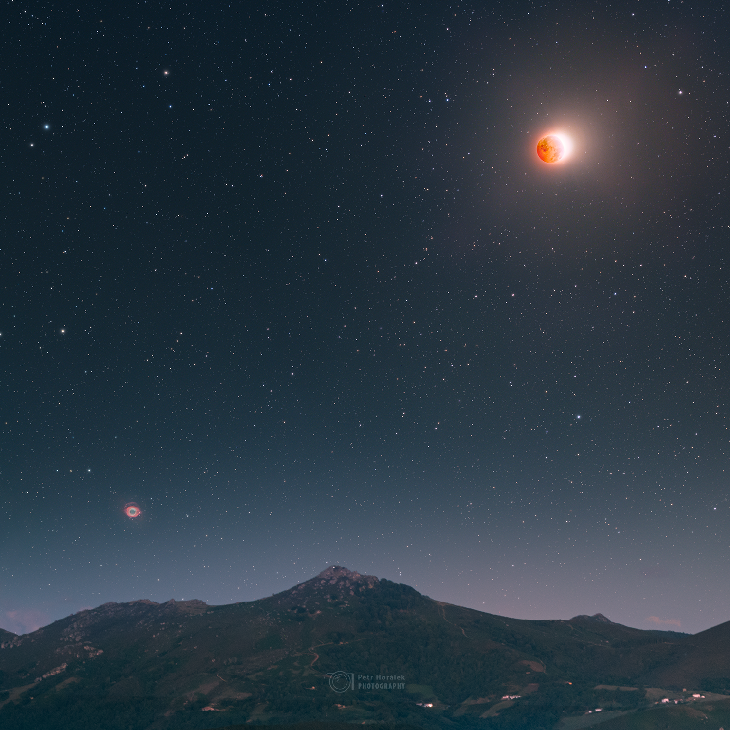
Eclipsed Moon, Helix Nebula, and Pyrenees
Taken by Petr Horálek, Josef Kujal on August 28, 2026 @
Ursuya Mount, France
Click photo for larger image

| |
Camera Used: Unavailable Unavailable
Exposure Time: Unavailable
Aperture: Unavailable
ISO: Unavailable
Date Taken: Unavailable
|
|
| More images
Details:
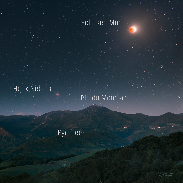
There was, actually, more during the recent lunar eclipse there was more. During it eclipse, the darkened Moon appeared angularly close to the well-known Helix Nebula (NGC 7293), also popularly nicknamed “God’s Eye”. This planetary nebula was formed about 12 thousand years ago by the death of a Sun-like star about 450 light-years away. It lies in the sky about 10° south of the ecliptic, i.e. the plane where a lunar eclipse can occur. But there is a catch: In order for the eclipsed Moon to lie angularly closest to the nebula, the eclipse must occur for only a few dozen hours around midnight from August 27 to 28. The last time such a situation occurred during a total lunar eclipse on August 28, 2007, and it will not occur again until August 28, 2072. This is therefore a very rare event. In the foreground of the image rises the Pyrenean mountain Pic du Mondarrin, towering 749 meters above the level of the nearby Atlantic Ocean.
Photographer's website:
https://www.petrhoralek.com/?p=26585
|
|
|