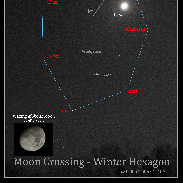
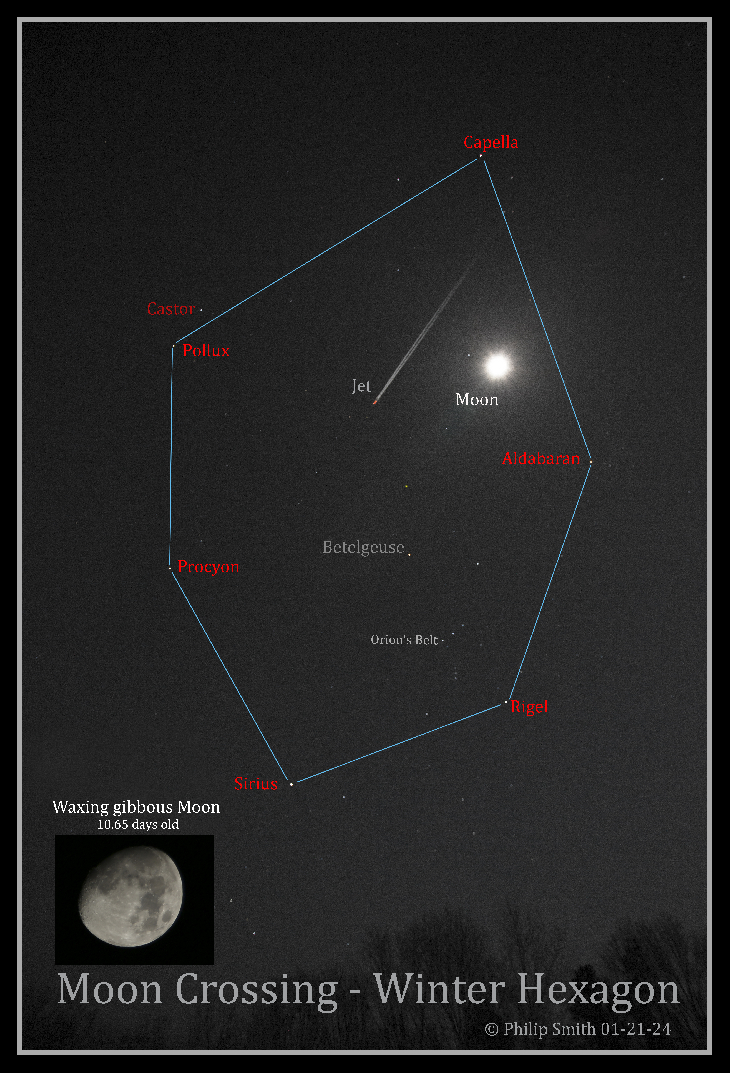
The Moon Crossing The Winter Hexagon
Taken by Philip Smith on January 21, 2024 @
Manorville, NY USA
Click photo for larger image

| |
Camera Used: Canon Canon EOS 5D Mark III
Exposure Time: 1/1
Aperture: f/2.8
ISO: 2000
Date Taken: 2024:01:22 04:05:53
|
|
| More images
Details:
I imaged a Jet aircraft and the Moon Crossing the Winter Hexagon also called the Winter Circle on 01-21-24 at 10:35PM from my Manorville Observatory. The Moon was a Waxing gibbous10.65 days old. I used a Canon EOS 5D Mark III / ISO 2000 / F-stop f2.8 / Exposure time 1 sec. / Focal length 18 mm. I tracked it using an AP1600GTO Mount.
The winter hexagon, which is not a constellation but an asterism, will sit high in the sky, and the moon will cross through over the course of a few days. The hexagon—sometimes referred to as the winter circle—is comprised of six of the brightest stars in the winter sky, each the most luminous star in a separate constellation.
The winter hexagon is visible monthly through the—surprise!—winter, starting in December. The moon will reach one side of the hexagon on January 13 and will move deeper into the shape each night through January 16, when it will arrive at the other side of the asterism.
The lowest edge of the hexagon will have risen above the southeastern horizon after sunset, per Space.com. It will stretch from just above the horizon to overhead and will move throughout the night. You can get a sense of the scale of the asterism in the image above from the NASA Jet Propulsion Laboratory. (Though, the actual diagram was not in reference to what the asterism will look like this month.)
The hexagon is edged with six easily identifiable stars, each part of a familiar constellation. Those constellations include Orion, Taurus, Auriga, Gemini, Canis Major, and Canis Minor. The six first magnitude stars in the winter hexagon are the recognizable blue of Sirius; Rigel, at the foot of Orion; bright Aldebaran; Capella, high in the sky; Pollux, one of Gemini's heads; and Procyon in Canis Minor. So, in addition to seeing the moon slide through the winter hexagon, the asterism can be your guide to seeing winter constellations.
You'll also be able to see bright Jupiter perched inside the hexagon during this stretch of days. There is a whole lot to see up there. The passage of the moon through the winter hexagon provides an alluring prompt to see what's happening overhead in the January sky.
Kind Regards To ALL 🙂
Photographer's website:
https://www.facebook.com/philip.smith.5686
|
|
|