| More images
Details:
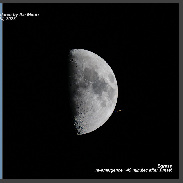
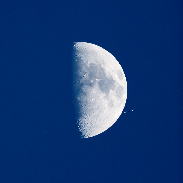
Here in SW Utah the occultation of Antares by the Moon started before sunset and ended in mid-twilight. I set up 2 scopes, my little Questar for visual and the big refractor for imaging. I spotted Antares at 40x in the Q about an hour before sunset. Pretty neat! I've never seen a star in daylight before. After its disappearance I took a half hour for dinner, then readied for the reappearance. It popped out from behind as instantly as it had disappeared; however, ingress was much more like magician's magic--one second it was there, the next second, poof, gone!--not by sleight of hand but by sleight of limb, for the Moon's night side blended in seamlessly with the daylit azure sky. While egress had less magic, the view of ruby Antares perched on the edge of the brilliant gray-white Moon in a dark sky had its own lustrous beauty.
Astro data: (all times MDT)
... ingress: 7:50:35pm (measured: 7:50:45pm +/- 10s) (~23 minutes before sunset)
... egress: 8:53:44pm (measured 8:54:00pm +/- 10s) (~40 minutes after sunset)
... sunset: 8:13pm
... C twilight ends: 8:41pm
... N twilight ends: 9:14pm
... A twilight ends: 9:47pm
Photo data:
Panasonic G9, Askar FRA 600, iOptron GEM45G
... Moon image: 1 x (f/5.6, 1/400 sec, ISO 200, EV -3)
... timelapse exposures done with the camera's semi-automatic Program mode
... timelapse: 1 frame every 50 sec
... ingress before sunset: 8 frames x (f/5.6, 1/500-1/400 sec, ISO 400, EV +1/3); timespan = 6.67 min
... egress after sunset: 13 frames x (f/5.6, 1/100-1/60 sec, ISO 400, EV +1/3); timespan = 10.83 min
... frames composited and processed in Paint Shop Pro X2
Photographer's website:
No URL provided.
|