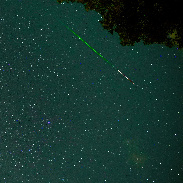
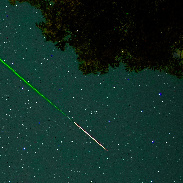
Perseid fireball
Taken by Aleksander Trębacz on July 29, 2024 @
Oxford, UK
Click photo for larger image

| |
Camera Used: SONY ILCE-7SM2
Exposure Time: 4/1
Aperture: f/1.0
ISO: 3200
Date Taken: 2024:07:30 17:21:48
|
|
| More images
Details:
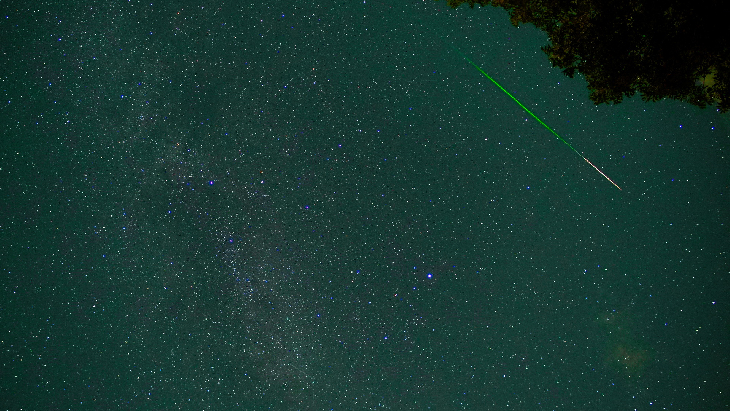
Last night, the first fireball from the most famous Perseid meteor shower appeared in the sky over Oxford. Although for over a week now, thanks to the excellent weather in England, we have been able to record several Perseids every night, this one was definitely the prettiest so far. I estimate its brightness at around -5 magnitude. The Perseids are active every year between July 20 and August 24. The maximum falls on the night of August 12-13, when you will be able to see over 60 meteors per hour, including several fireballs (very bright meteors - even brighter than the planet Venus, which has a brightness of -4m). This year, the Moon is in its first quarter, so it will only interfere a little, illuminating the sky in the first half of the night (actually until 11 p.m.). In the second half of the night, when there are usually the most flights, including fireballs, we will have a completely dark sky until dawn, so ideal conditions for observation. I highly recommend that you permanently enter this date in your calendar so that you can see this probably the most beautiful natural fireworks display of the year if possible. It is also definitely worth capturing them in photos.
Another piece of information for the curious. The bright end of the meteor in this photo and the green beginning of the tail are the effect of the so-called "cutting" of the camera shutter. In the previous photo, the beginning of the flight was still very faint. In this photo, the meteor was already at the end of its path in the atmosphere at an altitude of about 100 km. When the shutter opened for 4 seconds, it recorded the last stage of the flight of the dying meteor, but at the same time it recorded a column of ionized air glowing green for the next few seconds on the route of the lump of cosmic matter. In the photos from recent nights over England, you can also see a distinct green glow of the sky background. It is created in the upper layers of our atmosphere as a result of complex chemical reactions that have nothing to do with solar activity and the so-called aurora glow. It is actually always present but only its intensity changes - sometimes you can see it even with the naked eye but of course you can't see its green color because it is still too weak. This color can only be seen in photos taken at high sensitivity settings (so-called ISO) and with a suitably long exposure. In this case ISO 3200, time 4 seconds and aperture 2.0. (24mm lens and full frame).
Photographer's website:
No URL provided.
|
|
|