| More images
Details:
Since June's planet parade, Arizona's monsoon weather has shifted more northerly than usual, leaving SW Utah unusually cloudy for this time of year. Monday night it cleared up after an afternoon's rain but left the air rather humid (for a desert) and the sky hazy, not the best conditions to resolve this puzzle:
On Aug 10th Odd Trondal posted a photo of the supernova in NGC 7053 (link below). In it there are 3 other small galaxies. Ignore the closest one just E of 7053. The 2 that are farther out to the SSW and ESE are virtual twins--except the ESE one doesn't seem to exist. It's not in the Sloan photo he posted alongside for a reference photo, and it's not in the Palomar Sky Survey photo for the area either. What is it?
There are also a bunch of stars that appear in his photo and not in the reference photos. That might mean he used a filter (maybe IR?) that emphasizes stars in different wavelengths--filters weren't mentioned in the description. I don't think filters affect galaxies to such a degree as to make one disappear outright, but I could be wrong.
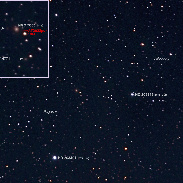
#1: My 90-minute exposure of the area on Aug 22-23 and annotations of the various objects in the FOV. The Type II supernova's current brightness is mag 17.1 (= 17m1), about the limiting magnitude of the scope's capabilities on the edge of town.
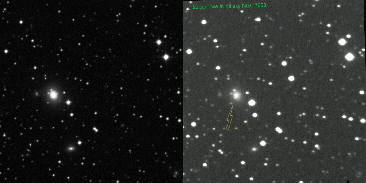
#2: Animated GIF of Odd's photo with the Palomar survey photo, which blinks the "galaxy" in and out.
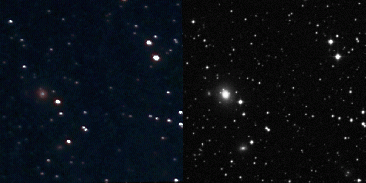
#3: Animated GIF of my photo with the Palomar survey photo. The Palomar photo goes deeper but there's no difference otherwise, and neither show a galaxy ESE of 7053.
The question is, "What is it?" A filter effect, an optical artifact, maybe even a comet?
Supernova data
Palomar Digital Sky Survey photos
Reference to Odd's photo
Photo data:
Panasonic G9, 5.5" Celestron Comet Catcher, iOptron GEM45G
... 90 x (f/3.64, 60 sec, ISO 1600) = 1.5 hr
... N up W right, FOV = 37' x 32'
... date: Aug 22-23, 2022 10:50pm-12:40am MDT (= Aug 23, 2022 4:50-6:40 UT)
Photographer's website:
No URL provided.
|