Spectral Emissions of Meteors
Taken by George Liv on August 16, 2019 @
Saint-Laurent, QC, Canada
Click photo for larger image

| |
Camera Used: Unavailable Unavailable
Exposure Time: Unavailable
Aperture: Unavailable
ISO: Unavailable
Date Taken: Unavailable
|
|
| More images
Details:
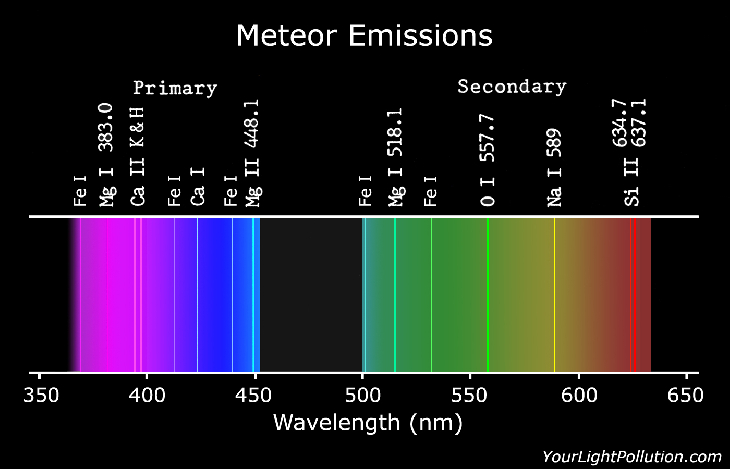
Meteors are NOT green. We see and photograph them green due to the combined effect of the type of meteor and our CURTAILED visual and digital spectral sensitivities. Meteors leaving a lingering train behind will also photograph greener. Meteor spectra acquired beginning in the 1970s for the purpose of determining their composition showed that meteors striking our atmosphere, like the meteorites found on earth's surface, are not all made of the same material. There are three basic kinds - iron, stony and stony-iron.
Despite the variety of meteor composition, iron turns out to be a major radiating element in most meteor spectra from faint to very bright meteors. But a large part of the complex radiation produced by iron is in the violet and ultraviolet part of the spectrum and is not readily visible to the naked eye or a stock digital camera. On the other hand, the radiation due to iron from about 360 to 440 nm can be recorded with modified digital bodies, naked CCD sensors and many discontinued films, provided that NO FILTERS are used over the lens or sensor.
Similarly, bright stony meteors, brighter than 1st magnitude, have K and H lines of singly ionized calcium that are overall dominant at 393.4 and 396.8 nm; these are also in the near ultraviolet. These occur with a total lack iron in these meteors. Another bright emission is produced by neutral magnesium atoms at about 383 nm, again in the ultraviolet. Indications are that for brighter meteors at least a quarter of their radiated energy is produced at invisible wavelengths in the near ultraviolet part of the spectrum. Other important emission lines that may vary in strength, particularly for the average meteor, are from neutral magnesium in the green, from the green auroral line of oxygen which is often the first wavelength appearing in a meteor trail, and in the yellow D-line 589nm of sodium. Diagram is my work. Meteor emissions are simplified by showing areas of the dominant and secondary regions with the positions of the brightest lines that are possible. Typically not all emissions can occur. Only very rich stony-iron meteors can approach the spectrum shown in the diagram.
Photographer's website:
https://yourlightpollution.com
|
|
|