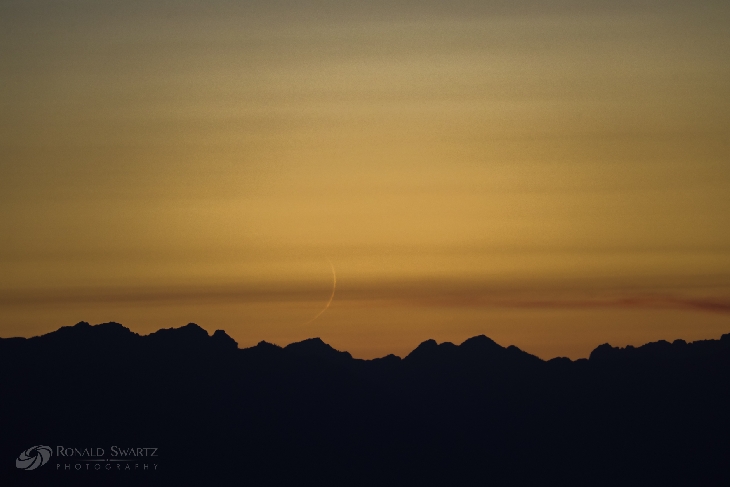
1.37 day old Crescent moon after solar eclipse
Taken by Ronald Swartz on August 22, 2017 @ Seattle, Washington, USA
Click photo for larger image
  Camera Used: Canon Canon EOS 5D Mark IV
Exposure Time: 1/20
Aperture: f/8.0
ISO: 800
Date Taken: 2017:08:22 22:24:56
 
More images
Details:
While a challenge to find, I managed to photograph the crescent moon 1.37 days after the Solar Eclipse of 2017. Taken from the Seattle, Washington waterfront, I almost missed it due to wildfire smoke on the horizon.
Photographer's website:
http://https://ronaldswartzphotography.com
Comments
  You must be logged in to comment.  
Nice catch! I was hoping to get this one too, a few hours earlier from southern NJ, but murky clouds above the western horizon precluded it. I especially wanted to see Tuesdays young moon since I saw the old moon on Sunday morning, the day before the eclipse on Monday, August 21, 2017. My old moon picture is in the SW gallery.

However, I wondered what your baseline was for the 1.37 days after the Solar Eclipse -- the beginning, the maximum or the end of the eclipse? That progression covered an approximate 2.5 hour span in Seattle.

Ultimately, I wondered what time the picture was taken. The time in the EXIF data, 22:24:56, looks improbable. 22:25 PDT would be 10:25 pm PDT, or about 1.5 hr after moonset. If it was UT, then it would be about 5.5 hr before moonset.

If its actually based on the moons age (typical for young moons), i.e., the time measured from new (18:30 UT or 11:30 am PDT on August 21), then 1.37 days after new would yield a picture time of 8:23 pm PDT, which sounds reasonable given that sunset was at 8:08 pm PDT. At 8:23 pm, the moon was at an apparent altitude of 3.8°. Moonset was at 8:51 pm PDT for Seattle.

Its not likely mid-eclipse, which was at 10:21 am PDT in Seattle. Adding 1.37 days (32 hr 53 min) to that would make the picture time 7:14 pm, almost an hour before sunset. The beginning of the eclipse, 1+ hr earlier, would similarly be ruled out. It could be the end of the eclipse (last contact), which was at 11:39 am PDT in Seattle, 9 minutes after new moon (the exact times of new moon and mid-eclipse are rarely the same). That would yield a picture time of 8:32 pm PDT, which is also reasonable (although the moon would have dropped to 2.5° apparent altitude by then).

For the northern hemisphere, the ecliptic is not at a favorable angle just after sunset this time of the year!
Posted by JoeStieber 2017-08-23 02:56:35
Hi Joe,
Thanks for the comment. I love your shot of the old moon, great capture with Earth shine!

Looks like the time was off on my camera (shame on me!). It was approximately 8:35 PM PDT (-8 UT) when I took this. I took the simple route when figuring out the age of the moon: I used Starry Night Pro 7 and set up the photo location and time. It then gave me the age as 1.37 days.
Posted by TGRonzo 2017-08-23 09:59:28
 
The Northern Lights: A Magic Experience
Aurora photo tours
Support SpaceWeather.com
Home | FAQ | Contact the Webmaster
©2019 Spaceweather.com. All rights reserved.