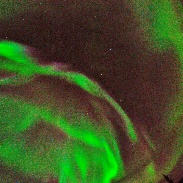
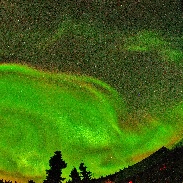
Auroras with a G2 Storm
Taken by Randall Preissig on September 11, 2015 @
Aurora Borealis Lodge, 20 miles north of Fairbanks, Alaska
Click photo for larger image

| |
Camera Used: NIKON CORPORATION NIKON D300
Exposure Time: 25/10
Aperture: f/3.5
ISO: Unavailable
Date Taken: 2015:09:11 09:57:35
|
|
| More images
Details:
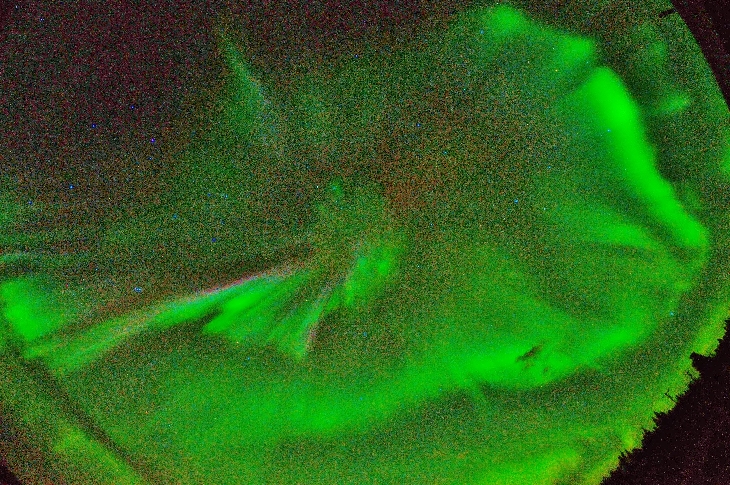
Aurora arcs visible directly overhead even at dusk. At midnight(Alaska time)a G3 storm hit and the aurora were moving very fast with reds visible to the naked eye. The corona passed overhead during this time. At 3AM (Sept. 11) a G2 storm hit and again the corona passed overhead. Interestingly, the aurora was mainly seen south, whereas it is usually mainly seen north of Fairbanks; this indicates big time aurora action.
These pictures are from the; G2 storm.
Nikon 300D, 8mm Fisheye at f3.5, mainly 2 sec exposures at ISO 3200. Note: the camera slightly accentuates the reds and tints them toward the purple.
For your information:
Strong (G3) Geomagnetic Storm Observed on 11 September 2015
published: Friday, September 11, 2015 12:54 UTC
The influence of a positive polarity coronal hole high speed stream caused an isolated period of G3 (Moderate) geomagnetic storms between 11/0600-0900 UTC (0200-0500 EDT). G2 (Moderate) geomagnetic storms were observed between 11/0900-1200 UTC (0500-0800 EDT) but the enhanced solar wind signature associated with this event is beginning to weaken and active to G1 (Minor) geomagnetic storms are expected throughout the remainder of the day.
A geomagnetic storm is a major disturbance of Earth's magnetosphere that occurs when there is a very efficient exchange of energy from the solar wind into the space environment surrounding Earth. These storms result from variations in the solar wind that produces major changes in the currents, plasmas, and fields in Earth’s magnetosphere. The solar wind conditions that are effective for creating geomagnetic storms are sustained (for several to many hours) periods of high-speed solar wind, and most importantly, a southward directed solar wind magnetic field (opposite the direction of Earth’s field) at the dayside of the magnetosphere. This condition is effective for transferring energy from the solar wind into Earth’s magnetosphere.
Photographer's website:
No URL provided.
|
|
|