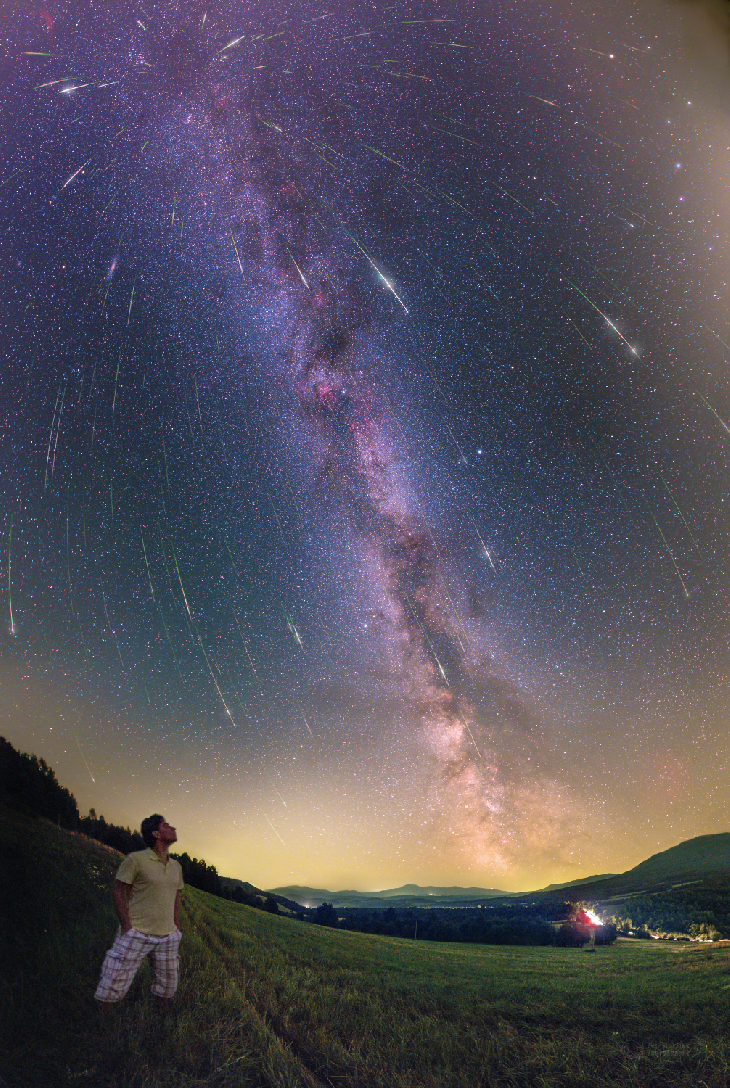
The Perseid rain over the Kolonica Saddle
Taken by Petr Horálek on August 8, 2015 @
Kolonica Saddle, eastern Slovakia
Click photo for larger image

| |
Camera Used: Unavailable Unavailable
Exposure Time: Unavailable
Aperture: Unavailable
ISO: Unavailable
Date Taken: Unavailable
|
|
More images
Details:
The annual meteor shower Perseid had absolute great conditions this year. New Moon occurred just day after the maximum as it was about 6:30 to 9:00 UTC on August 13th, 2015. Last time the „moonless Perseids“ were in 2013 and the next time we will enjoy that in 2018. I took a risk for possible bad weather and chose amazing locality of eastern Slovakia, where can be found the Poloniny Dark Sky Park. The decision showed up to be absolutely great. Even if the dusty and dry weather (with almost all nights without clouds!) highlighted the light pollution of far cities, especially in the Ukraine, the silvery Milky Way was such beautiful at least higher above the horizon. As a member of meteoric expedition for youth at the Kolonica observatory I had great hinterland for capturing as much Perseid meteors as I could. I spent glorious 6 nights under the Poloniny sky and captured this fantastic portrait of the meteor shower. You can count 174 meteors of the Perseids, captured between 8th and 14th August 2015. Watching the skies on the image, I was standing there above the Kolonica Saddle and enjoying the show despite a danger of negligible presence of the wild Brown bears. The brightest fireball in the upper part of the image was about -7 magnitude and followed by colorful meteoric „smoky“ trail (this one fallen on 14th August just a two hours before the daybreak). In the Milky Way there are numerous nebulae as NGC 7000 „The North America“ or NGC 896 „Heart and Soul“. The colors of the meteors are caused by the energy of excitation of the Nitrogen and Oxygen in our atmosphere between 160 and 80 km above the ground, where is the energy given to the air by the debris of the comet 109P Swift-Tuttle with entry speed about 59 km/s. The comet invited the inner Solar System in 1992 and next time return is being more less planned for our children or grandchildren in 2126. But the meteor shower remains us the comet every year…
Used Canon 6D IR Baader Modified, Sigma 15 mm (f2.8). For the image is used multiexposure of the sky and sticked to the foreground. The meteors were registered for geometric correction and added to the sky mask individually. Sky is mosaic of 4 segments, each 30×120 s from EQ-3 mount, darkframes applied (aperture set to f4.5, ISO 4000). Foreground from tripod, mosaic of 2 segments, each 30×20 s, darkframes applied (aperture set to f3.5, ISO 8000). Meteors were captured with the same setting as the foreground (and also applied darkframes). The image is, actually, result of work with about 120 GBs of data, which were used for calibrations, stacking, sticking and creating this unusual view to the probably most favorite meteor shower of northern summertime.
More: http://www.astronom.cz/horalek/?p=1700
Photographer's website:
http://www.astronom.cz/horalek
|
|
|