Aurora Borealis
Taken by Dennis Mammana on July 27, 2004 @
Borrego Springs, CA, USA
Click photo for larger image

| |
Camera Used: Unavailable Unavailable
Exposure Time: 30/1
Aperture: f/1.6
ISO: Unavailable
Date Taken: 2014:05:27 17:21:44
|
|
| More images
Details:
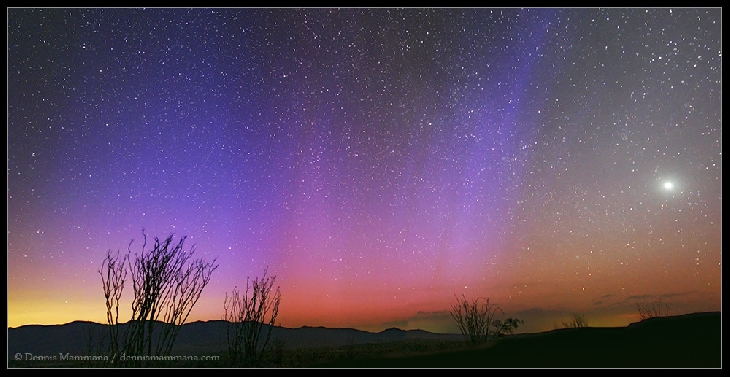
It was ten years ago--during the pre-dawn hours of July 27, 2004--that the Anza-Borrego Desert of Southern California was bathed in the most unusual of light—that of the aurora borealis. On this morning it danced over so wide an area of the northern sky that it required four wide-angle images stitched carefully together to capture it all.
As the sky darkened the night before, solar data had me convinced that we in the Desert Southwest might just get a rare display of northern lights, so I aimed a camera north and set it to take one exposure every minute, while I kept watch on the incoming data on the computer. From time to time I checked the camera’s LCD screen to see if it had captured anything of interest. Then, just before 4 a.m., I discovered blue streaks across the image. “What a lousy time for the sensor to crap out on me!”, I thought. But as I scrolled through the previous images to learn where it went bad, I watched as the blue streaks danced gracefully across the scene. It was the northern lights!
I hastily threw all my gear in the back of the Jeep and headed for an interesting foreground a couple of miles away. And the photo you see is the result--perhaps the only image of the northern lights with ocotillos in the foreground!
The temperature at the time was already a sweltering 95F/35C, and I stood in the middle of Borrego Springs Road (S3) wearing nothing but short pants… quite a difference from the Michelin Tire Man appearance I must have when shooting the lights from arctic regions during winter. The yellowish glow behind the Santa Rosa Mountains is light from distant desert cities and I-10 corridor to the north and northwest, and the bright "star" on the right is the planet Venus in the northeast.
• Photo Details: Canon 10D, 24mm f1.4L lens, ISO 800, 30 seconds at f/1.6; four segments
• Date / Time: July 26/27, 2004 / 04:06:07 a.m. to 04:09:34 a.m.
• Processing Details: Noise Ninja 2.3.2, PTGui Pro 7.2, PhotoShop CS2
Photographer's website:
http://www.dennismammana.com
|
|
|