First Comet ISON
Taken by Giuseppe Petricca on November 16, 2013 @ Pisa, Tuscany, Italy
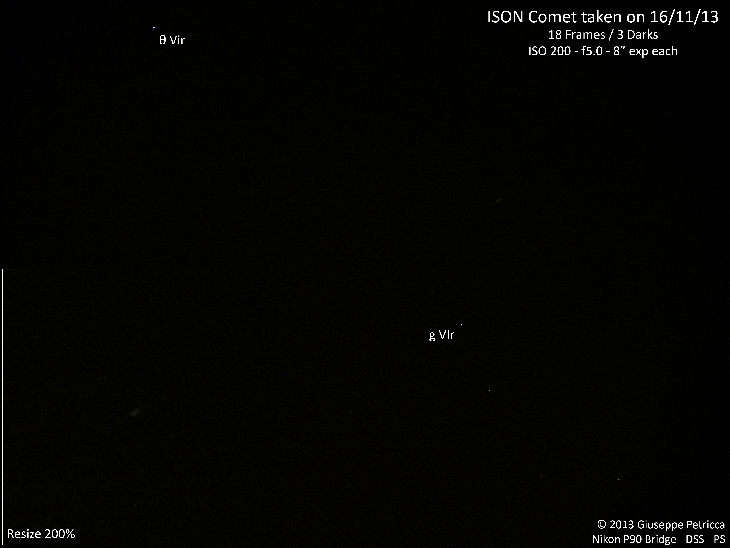
Click photo for larger image
  Camera Used: NIKON COOLPIX P90
Exposure Time: 800/100
Aperture: f/5.0
ISO: 200
Date Taken: 2013:11:16 09:23:06
 
More images
Details:
This morning I managed to take a pic of Comet ISON for the first time! The photo is a stack of 18 different exposures and 3 darks done with DSS. Please note that the original photos were taken with a non-reflex digital camera, a Nikon P90. The comet is there, faint and tiny, but it's her!
Photographer's website:
http://www.gmrphotographer.net
Comments
  You must be logged in to comment.  
May be you could push up the iso to 800 to have more sensitivity and more details. Only a constructive criticism.
Posted by Dom 2013-11-16 11:24:47
Thanks for the advice Dom. I tried to push on ISO 400, but the amount of noise increased exponentially! So I went back to 200.

Any advice on what I can do to eliminate that big amount of noise? Maybe take more dark frames? Or something else?
Posted by Stormchaser 2013-11-16 12:15:47
A higher ISO and longer exposure time along with a lower F/ ratio is what you need. Are you having issues tracking or is this taken on a tripod?

I would suggest ISO 800 for 30 secs minimum to get the snr you need.
I never used the P90 so I dont know what the noise is like, but you will need a few dark frames to get rid of the noise.

What kind of image processing software do you use?

Brian
Posted by Brian Larmay 2013-11-16 17:37:27
Thanks a lot Brian. This is on a tripod, and the thing is, since the P90 is not a reflex, that I cannot go down f5.0 at that zoom level, and I cannot go up 8 of exposition because the factory settings of the camera.

I used DeepSkyStacker first, then Photoshop. So, since I have a little my hands tied from the factory sets, I tried doing a lot of shots in ISO 200 etc. etc., but the noise is still there, and the snr of the comet is really low...
Guess I have to retry with what you are telling me, an higher ISO setting and more dark frames to try to eliminate as more noise as possible.
Posted by Stormchaser 2013-11-16 22:45:39
If you have at leaste a B (bulb) setting on the camera, and if you do not have a shutter release cable, you can use a rubber band to go around the camera so it overlaps the shutter button, and u can wedge something in there to keep the shutter open until you are done with the exposure. Use the hat trick over the lens so you dont have any jittery stars before you end your exposure.
Ive done this with my canon 60D when I forgot my release cable.

Push the film speed as high as it can go, ISO1600 or 6400 to eliminate trailing of the stars.
I know it will increase noise, but you can use various software or techniques to minimize it.
Good luck to you.

Brian
Posted by Brian Larmay 2013-11-19 08:44:37
I just read about the P90 and there is not a bulb mode so what I suggested will not work :(
I guess you can goto an online camera barter website and either buy a cheap used digital camera with a bulb setting if money is an issue, or if not, go get a new one.

I wish you the best,
Brian
Posted by Brian Larmay 2013-11-19 08:51:39
 
The Northern Lights: A Magic Experience
Aurora photo tours
Support SpaceWeather.com
Home | FAQ | Contact the Webmaster
©2019 Spaceweather.com. All rights reserved.