| More images
Details:
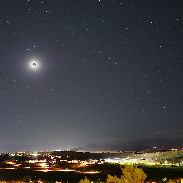
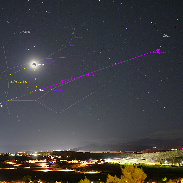
Whenever 4 objects in the sky create a small(ish) rectangle it makes for a striking visual feature. Twice already this year Pollux and Castor have formed one side of such a box shape with Jupiter and the Moon on the other side. Jupiter has moved on in its orbit but now Mars gets in on the act. The photo about taken 2 hours before dawn. In 3.5 more hours the rectangle will be virtually perfect, except that the sun will be rising then.
Note also that Mars is about to cross the Alhena Line (it does this late Sunday afternoon), so Monday morning will see it on the other side. Pollux and Mars are currently the same brightness (mag 1.2) with Betelgeuse a half magnitude brighter (0.6) and Alhena about a half magnitude fainter (2.0), so all of them are pretty similar brightnesses and pretty evenly spaced.
Pollux and Betelgeuse define the line, but its special characteristic is that the brightest star between them, Alhena, appears to be exactly on the line, not merely near to it. With Alhena at the 2/3rds point (from Pollux) and the ecliptic crossing the line near the 1/3rd point, any planet crossing the line is guaranteed to put on a show that splits the line into thirds. The Moon crosses the line too, of course, but with an orbit that fluctuates 5* above and below the ecliptic, it's not obvious (to me) that it'll always cut the line into relatively even slices that are aesthetically pleasing. Also, on fall mornings the line is rather tilted and its collinearity is unclear, whereas on spring evenings it's almost perpendicular to the horizon (at least at latitude 37* N.), which highlights the collinearity.
Labelled and unlabelled photo. The Moon is 2+ days past last quarter and composited in.
Photo data:
Panasonic GX8, Lumix 20mm lens, tripod
... stars: (f/2, 10 sec, ISO 400)
... Moon: (f/2, 1/500 sec, ISO 400)
... date: Sep 6, 2026 3:39am MDT
Photographer's website:
No URL provided.
|