The August Eclipse Pair
Taken by Alessandro Carrozzi on August 28, 2026 @
Palencia, Spain; Carpineti, Italy
Click photo for larger image

| |
Camera Used: Canon Canon EOS 6D
Exposure Time: 1/2000
Aperture: Unavailable
ISO: 400
Date Taken: 2026:08:29 12:52:53
|
|
| More images
Details:
Eclipses tend to occur during so-called eclipse seasons: short periods when the geometry of the Sun, Earth, and the Moon’s orbit makes particularly precise alignments possible. This is why a solar eclipse at New Moon can be followed, about two weeks later, by a lunar eclipse at Full Moon.
In August 2026, this geometry produced a particularly remarkable combination: a total solar eclipse followed just 16 days later by an extremely deep partial lunar eclipse, almost total, both visible from broadly the same part of Europe.
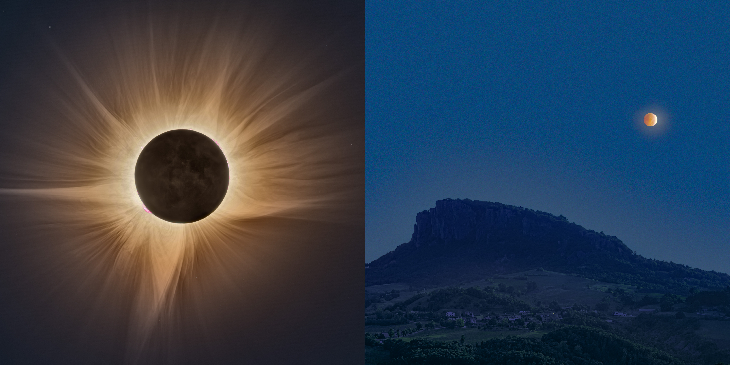
In the image on the right, the moment of solar totality, photographed near Palencia, Spain: just over 100 seconds during which the photosphere disappeared and the faint outer atmosphere of the Sun became visible. To reproduce the enormous dynamic range of the corona, 55 photographs taken at different exposure times were combined into an HDR image and then carefully processed to enhance the contrast of the coronal structures and filaments, revealing details that no single exposure — and not even the human eye — can perceive all at once. The Sun’s very low altitude above the horizon, together with suspended Saharan dust, also gave the corona its unusual yellow-orange hue.
On the left, sixteen days later and about 1200 Km further east, the Moon, almost entirely immersed in Earth’s shadow, sets behind Pietra di Bismantova in the northern Apennines of Italy. Here, the scene is dominated by the deep blue tones of twilight. This image also required careful contrast enhancement, as atmospheric humidity and, once again, suspended Saharan dust greatly reduced visibility and contrast.
Two very different images, separated by just sixteen days yet produced by the same celestial geometry: first the Moon between us and the Sun, then the Earth between the Sun and the Moon.
Technical details
Sun
William Optics Megrez 90/621 mm
ZWO AM5N
Canon EOS 6D
Moon
Canon EOS 6D
Nikkor 85 mm f/1.8
Photographer's website:
https://www.flickr.com/photos/151655471@N07/
|
|
|