Galileo's Illusion or Irradiation illusion
Taken by PAOLO PALMA on June 11, 2026 @
Roma - Italy
Click photo for larger image

| |
Camera Used: Unavailable Unavailable
Exposure Time: Unavailable
Aperture: Unavailable
ISO: Unavailable
Date Taken: Unavailable
|
|
| More images
Details:
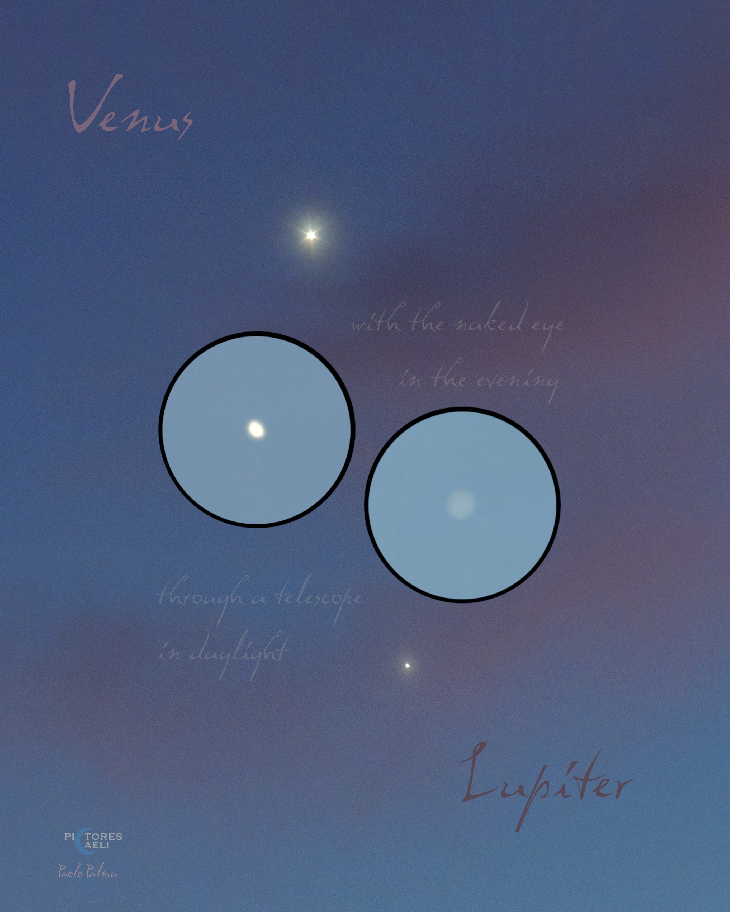
this composite image that combines a view of the last Venus-Jupiter conjunction with the shots of these two planets taken through the telescope. A comparison that demonstrates the so-called ‘Galilean optical illusion’.
The beautiful dance performed by Venus and Jupiter in June captured everyone’s attention, but only those who observed them through a telescope would have noticed a most peculiar detail: whilst to the naked eye Venus appeared many times LARGER than Jupiter, through a telescope its apparent diameter turned out to be significantly SMALLER than that of the gas giant!
So who is lying: the telescope or our eyes?
On those evenings, Venus was five times closer than Jupiter, but as it is 12 times smaller, it should have appeared smaller than the gas giant. The liar, then, was not the telescope, but our eyes… just as Galileo had discovered 400 years ago:
‘I have often seen Jupiter and Venus together […] and Venus appeared to be as much as eight or even ten times larger than Jupiter when viewed with the naked eye; but when observed through the telescope, Jupiter’s disc was actually four or more times larger than that of Venus.’
In short, as darkness falls, the stars seem to be cloaked in a halo of luminous rays that only begin to fade with the arrival of dawn. This nocturnal halo is so dense that it makes them appear not only brighter, but also much larger than they actually are!
It is the ‘irradiation illusion’, more commonly known as Galileo’s optical illusion, because although the mechanisms behind it were only explained a few years ago, it was Galileo himself who first observed it and realised that its causes lay in the functioning of the human eye:
‘Bodies shining with the brightest light radiate far more than those with a duller light […] This is largely due to the limitations of our own eye, which presents shining objects […] to us encircled by such long and dense accidental rays that their bare little bodies appear magnified to us.’
Due to the irradiation illusion, the brighter the celestial bodies, the larger they appear to us. And the effect is all the more pronounced the brighter they are and the darker the background in which they are set.
I took the conjunction on 11 june 2026. And I took the planets through a Sky-Watcher Dobosn Stargate Telescope at 95x on 3 June 2026 with a Huawei p30 pro.
Photographer's website:
https://www.unsaltonelcielo.it
|
|
|