| More images
Details:
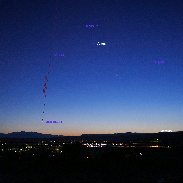
Mercury was spotted in 7x35 binoculars about 20 minutes before setting, and the photo was taken about 10 minutes later.
Venus and Jupiter reach a close conjunction on June 8-9, and Mercury is racing upwards to catch up with them. Before then, Venus crosses the Alhena Line (the straight line between Pollux and Betelgeuse, including Alhena) on June 2nd, which has potential as an interesting sight by chopping it up into 3 quasi-equal lengths--but that depends on being able to see the line in its entirety. However, Betelgeuse will be gone for the season by then, and Alhena, though still above the horizon, may well be invisible in the ever-later sunset glow.
Mercury crosses the line on June 13-14, but by then it's likely that only the 3 planets remain visible to the naked eye--no bright stars for context. Mercury is at its greatest eastern elongation on June 15th. Afterwards, it's Jupiter chasing Mercury down to the western horizon until they both disappear as July starts.
The New Moon joins the planetary fray Jun 15-17 for many photo op's. On Jun 17th two notable events occur: lunar occultations of Venus and, 6 hours later, the Beehive cluster; unfortunately, for our area they occur during daylight. By the time darkness arrives those shows are over, though the crescent Moon next to the Beehive (and Venus on the other side) should be pretty.
Photo data:
Panasonic GX8, Lumix 20mm lens, handheld
... (f/1.7, 1/15 sec, ISO 400)
... date: May 23, 2026 9:30pm MDT (sunset at 8:42pm, dark at 10:30pm)
Photographer's website:
No URL provided.
|