More images
Details:
 |
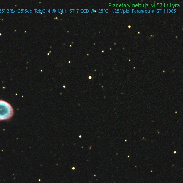
The Planetary Nebulae season is here. Here are RGB, H-Alpha & O-III images using my new filter wheel.
In astrophysics we have some "crazy" notations. For example :
Neutral hydrogen (Symbol: H in physics & chemistry) is called H-I in astrophysics, and 1 time ionized hydrogen (H+) is called H-II.
Neutral oxygen (Symbol: O in physics & chemistry) is called O-I, single ionized oxygen (O+) is called O-II and double ionized (O++) is called O-III.
https://en.wikipedia.org/wiki/Doubly_ionized_oxygen
https://en.wikipedia.org/wiki/H_II_region
Also old fashioned units are often still used. For example :
Erg for energy ( In physics Joule (symbol: J) )
https://en.wikipedia.org/wiki/Erg
Angstrom for lenght (In physics Nanometer (symbol: nm) )
https://en.wikipedia.org/wiki/Angstrom
Today most astro-photographers who are using narrow band filters, use Nanometers. So there is a trend towards using the modern SI units.
And I agree on what Don Lincoln always says: "Physics is Everything"
https://youtu.be/W3ERzlC2fgM?si=FlkiXGHkEQ_I51Ms
M 57 was discovered by the French astronomer Antoine Darquier de Pellepoix in 1779.
https://science.nasa.gov/mission/hubble/science/explore-the-night-sky/hubble-messier-catalog/messier-57/
https://en.wikipedia.org/wiki/Antoine_Darquier_de_Pellepoix
Time: 23:35UT 2026-05-05 Filter & Exp. R(5x30) G(4x65) B(8x125)Sec
Tel: C14 @ f/4.1 ST-7 CCD @ -25°C 1.28"/pix Paramount GT-1100S
Odd Trondal Obs.code 238 (Uranium). Oslo Norway.
Software used:TheSky6,CCDSoft 5, MSB Astroart 2.0, 8.0, Paint
Previous Planetary Nebulae images :
The small ring nebula in the constellation Lyra
A planetary nebula in the constellation Cepheus
Photographer's website:
https://www.flickr.com/photos/odd_trondal/
|