AR4392
Taken by Pepe Manteca on March 18, 2026 @
Begues
Click photo for larger image

| |
Camera Used: Unavailable Unavailable
Exposure Time: Unavailable
Aperture: Unavailable
ISO: Unavailable
Date Taken: 2026:03:18 13:58:44
|
|
| More images
Details:
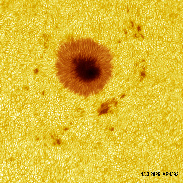
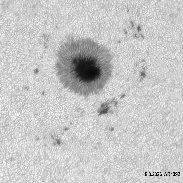
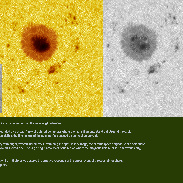
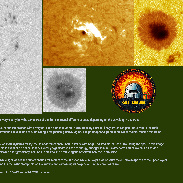
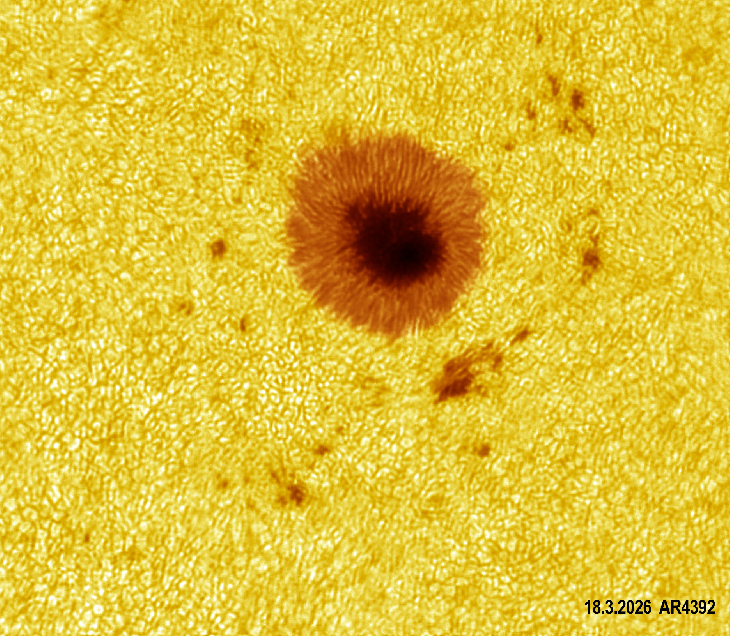
The active region AR4392, photographed on March 18, 2026, shows very clearly how the same area of the Sun can reveal different aspects depending on the wavelength observed.
In white light, obtained with the 14" Schmidt-Cassegrain, the main sunspot can be seen with a very dark and compact umbra, surrounded by a broad, finely structured penumbra, where the radial filaments stand out. Around the spot, pores and small dark concentrations can also be seen, indicating a magnetically active region. The photospheric granulation is also visible, the fine texture of the solar surface caused by convection currents.
In H-alpha, captured with the Lunt 150, the same region shows a much more dynamic reality: the solar chromosphere in full activity, with bright, twisted structures surrounding the spot. In this image, the chromospheric signature of a solar flare associated with an M-class event can be seen, that is, a clearly significant release of energy, stronger than a C-class event and below an X-class one. The large bright area reveals the region where the magnetic field released energy violently, heating the plasma and producing the observed increase in emission.
The comparison between both images is especially interesting: in white light we see the photospheric architecture of the sunspot, while in H-alpha we observe the eruptive response of the upper layers of the solar atmosphere. In a way, it is the difference between seeing the magnetic “footprint” on the surface and witnessing its “explosion” in the chromosphere.
Images captured with a 14" Schmidt-Cassegrain and a Lunt 150, using ASI174MM and ASI432MM cameras.
Photographer's website:
No URL provided.
|
|
|