Near-Earth asteroid 2026 CQ3
Taken by Filipp Romanov on February 16, 2026 @
Liverpool Telescope, La Palma, Canary Islands
Click photo for larger image

| |
Camera Used: Unavailable Unavailable
Exposure Time: Unavailable
Aperture: Unavailable
ISO: Unavailable
Date Taken: Unavailable
|
|
| More images
Details:
How I found the near-Earth asteroid 2026 CQ3:
On February 15, 2026, at the 2-m Liverpool Telescope, I requested the imaging of 15 photos (with 60-sec exposures) of the area of the sky in the constellation Leo to confirm one of the Main Belt asteroids I had found. When they were completed and I looked through them, I saw a fast-moving (about 18 arcsec/min) faint object (and immediately assumed - based on the speed of its movement - that it was most likely a near-Earth asteroid): I made astrometric measurements and sent them - under the temporary designation RFD0284 - to the NEO Confirmation Page https://minorplanetcenter.net/iau/NEO/toconfirm_tabular.html of the Minor Planet Center - for the possibility of confirmation by observations from other observatories.
Due to the fact that several hours passed between the time of shooting and the time of sending the data, the error in the predicted position of the asteroid in the sky was already quite large, therefore, there was a high probability that the asteroid would not be confirmed, i.e., would be lost. Additionally, I sent a message with information about this asteroid to the Minor Planet Mailing List: as a result, on the same date it was confirmed at the McDonald Observatory, after which its position in the sky became known with good accuracy, so additional observations were made from several other observatories. On February 16, 2026, the electronic circular MPEC 2026-D07 was published https://www.minorplanetcenter.net/mpec/K26/K26D07.html about the discovery of this asteroid and assigning it the designation 2026 CQ3.
Orbit type: Amor https://minorplanetcenter.net/db_search/show_object?utf8=✓&object_id=2026+CQ3 , Its absolute magnitude is H = 25.5 (its size is approximately 15 to 50 meters), its orbital period is almost 1.4 years https://ssd.jpl.nasa.gov/tools/sbdb_lookup.html#/?sstr=2026%20CQ3&view=VOPC On February 13, 2026, it passed by Earth: the distance was about 21 LD (distance from the Earth to the Moon); that is, I found it already when it was moving away from Earth, and automatic sky surveys did not detect it (only after my report of the asteroid and several confirming observations it was found in the Mount Lemmon Survey images of February 10, which allowed for improved data on its orbit), that is, if I had not found it, it would have been missed. Its maximum brightness was around +20 mag, meaning it couldn't be detected with small telescopes. I should add that the probability of such a detection was low, as the IO:O camera at the Liverpool Telescope, which I used, has a field of view of only about 10x10 arcmin, but the asteroid appeared in the field of view during the imaging.
I will add: of the more than 1.5 million known asteroids, only slightly more than 41,000 are near-Earth (this is a rare discovery for an amateur astronomer). I will clarify that this is the second near-Earth asteroid I have found: the previous one, 2024 QS, was in August 2024, and I wrote a scientific paper about it and recently submitted it for publication. Interesting fact: on the same dates — on the night of February 15/16 — in 2013, for the first time I observed and photographed a near-Earth asteroid, 2012 DA14.
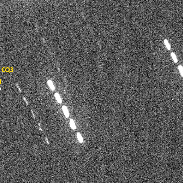
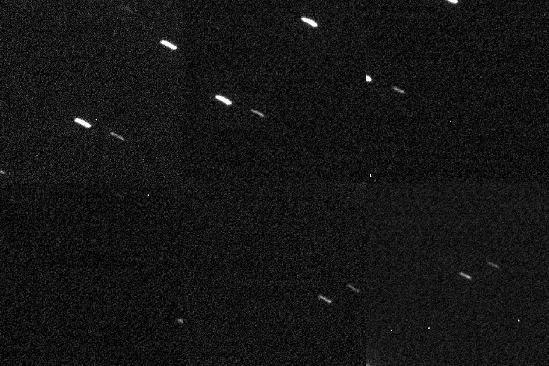
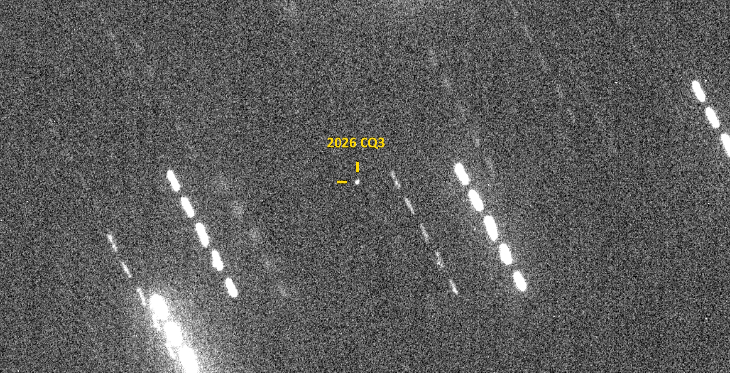
I am attaching: a photo of asteroid 2026 CQ3 and an animation of its flyby: from photographs taken on 16.02.2026 at the Liverpool Telescope.
I am currently the discoverer (by the self-aducation): of 82 variable stars, 10 planetary nebula candidates, 3 novae in the Andromeda Galaxy, 3 supernovae (two co-authored, one personally), 4 astronomical transients (possible supernovae), 4 pairs of binary stars, and 12 asteroids; I am the author and co-author of scientific papers on astronomy, published, among others, in peer-reviewed scientific journals. The most recent one is the preprint "AT 2025abao: the fourth luminous red nova in M 31" https://arxiv.org/abs/2602.13678 for February 2026.
Photographer's website:
https://www.facebook.com/romanov.philipp
|
|
|