Globular Cluster Palomar 13 in Pegasus
Taken by Tom Wildoner on October 20, 2025 @
Weatherly, PA, USA
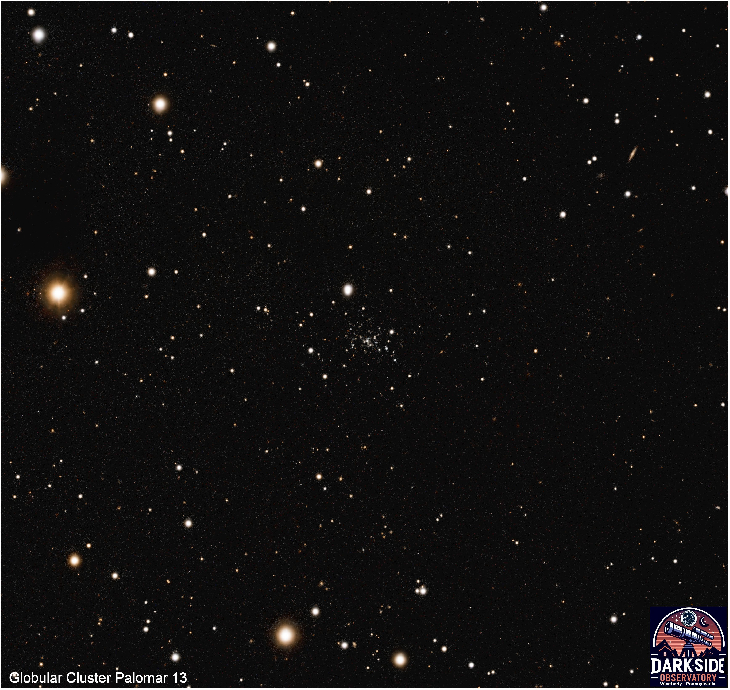
Click photo for larger image

| |
Camera Used: Unavailable Unavailable
Exposure Time: Unavailable
Aperture: Unavailable
ISO: Unavailable
Date Taken: 2025:12:21 06:42:23
|
|
| More images
Details:
Palomar 13 is a small and unusually sparse globular cluster located in the constellation Pegasus, far out in the halo of the Milky Way. Discovered in 1955 as part of the Palomar Observatory Sky Survey, it is one of the least massive and faintest known globular clusters. Palomar 13 is made up of very old, metal-poor stars, but unlike most globular clusters, its stars are loosely bound and appear to be slowly drifting away, possibly due to tidal interactions with the Milky Way. Because of this, astronomers consider Palomar 13 to be in the process of dissolving, making it an important object for studying how globular clusters evolve and break apart over time.
RA: 23:06:44.44
Dec: +12:46:19.2
Distance from Sun: 84.8 kly
Distance from Galactic Center: 87.7 kly
Apparent Diameter: 2.2 arc min
Brightness: 13.47 mag vis
Tech Specs: Meade 12” LX-90 SCT Telescope, Antares Focal Reducer, ZWO ASI2600MC camera running at -10F, 216 x 60 seconds, Celestron CGX-L pier mounted, ZWO EAF and ASIAir Pro, processed in DSS and PixInsight. Image Date: October 20, 2025. Location: The Dark Side Observatory (W59), Weatherly, PA, USA (Bortle Class 4).
Photographer's website:
https://www.thedarksideobservatory.com
|
|
|