sunspot
Taken by Mohammad Fadel Talafha on September 7, 2025 @
University of Sharjah, S120, University City, Sharjah, SAASST , ARE
Click photo for larger image

| |
Camera Used: Unavailable Unavailable
Exposure Time: Unavailable
Aperture: Unavailable
ISO: Unavailable
Date Taken: 2025:09:08 14:19:11
|
|
| More images
Details:
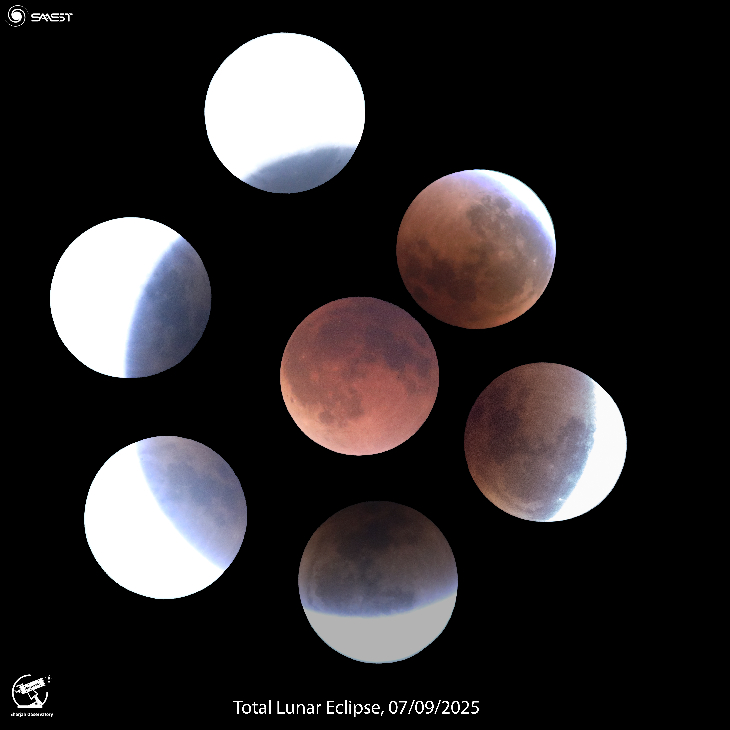
This image beautifully demonstrates that the Moon is much smaller compared to Earth’s shadow. The fact that the entire lunar disk fits well inside the shadow proves how dominant Earth’s size is in the Sun–Earth–Moon system. During a lunar eclipse, the Earth blocks sunlight and casts a conical shadow into space, known as the umbra. At the distance of the Moon, this umbra is about 9,200 km in diameter, while the Moon itself is only about 3,474 km across or almost earth shadow more extensive by 2.6 to 2.8 times of Moon's apparent diameter. This means the Earth’s shadow at the lunar orbit is nearly three times wider than the Moon, allowing the lunar disk to be fully immersed during total eclipses. The sequence of images highlights this scale difference clearly: as the Moon gradually enters and exits the umbra, it takes several hours to cross the shadow, further emphasizing how much larger the shadow is compared to the Moon’s size. The central red phase, known as totality, illustrates the depth of Earth’s shadow, where the only light reaching the lunar surface is sunlight filtered and refracted by Earth’s atmosphere. Together, these stages show both the elegance of celestial alignment and the geometry of eclipses, reminding us of Earth’s relative size and its commanding presence in shaping the visual spectacle we observe from the ground.
Photographer's website:
https://www.saasst.ae/
|
|
|