| More images
Details:
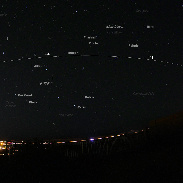
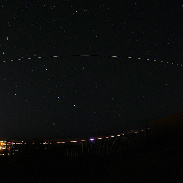
The ISS made an evening pass right at dark across the NW sky while narrowly avoiding a collision with Arcturus. Labelled and unlabelled versions.
The Big Dipper is featured in the center. The Pointer stars, Dubhe and Merak in Ursa Major, point to Polaris and the North Celestial Pole, while the Guardian stars, Kochab and Pherkad in Ursa Minor, march around the pole keeping tabs on things.
Thuban in Draco was the pole star when the Great Pyramids were built ~4500 years ago.
Gemma (aka Alphecca, alpha CrB) in Corona Borealis waits to see if its nearby rival, the recurrent nova T Coronae Borealis (aka the "Blaze Star"), will ever wake up and attempt to outshine it. Something I've noticed in the quest to see the Blaze Star is that Gemma is the brightest star of its magnitude level (mag 2.2) within a ~20° radius of it--Alkaid is probably the closest match. (One would never mistake Arcturus for Gemma or vice versa.) In other words, when the Blaze Star goes off, the section of sky with "2 Gemma's" in it should command itself immediately to the naked eye.
Canes Venatici are the hunting dogs belonging to Boötes. Unlike Orion, who couldn't be bothered to name his dogs (Canis Major, Canis Minor--Big and Little Dogs--how personal), Boötes was more involved with his dogs and gave them rather poetic names: Asterion ("Starry") and Chara ("Joy"). Cor Caroli (alpha CVn) and the star Chara (beta), the constellation's two brightest stars, mark the body of Chara the dog, while a little grouping of stars NE of Cor Caroli denotes Asterion. Cor Caroli itself is a pretty double star of white and yellow that's easy to split in a small scope.
Finally, if you draw the constellation of Cepheus as a kid's idea of a house, Errai (gamma Cep) marks the peak of the roof. 2/3 of the way from Errai to Polaris is the sky's northernmost open cluster, NGC 188. It's believed to be one of the oldest open clusters in our galaxy.
Photo data:
Panasonic GX8, Olympus 9mm 140° semi-fisheye lens, tripod
... 15 frames x (f/8, 15 sec, ISO 800) = 3m 45s
... date: Sep 10, 2025 at end of evening twilight
Photographer's website:
No URL provided.
|