About my discovery of supernova SN 2025umq
Taken by Filipp Romanov on August 24, 2025 @
Liverpool Telescope, La Palma, Spain
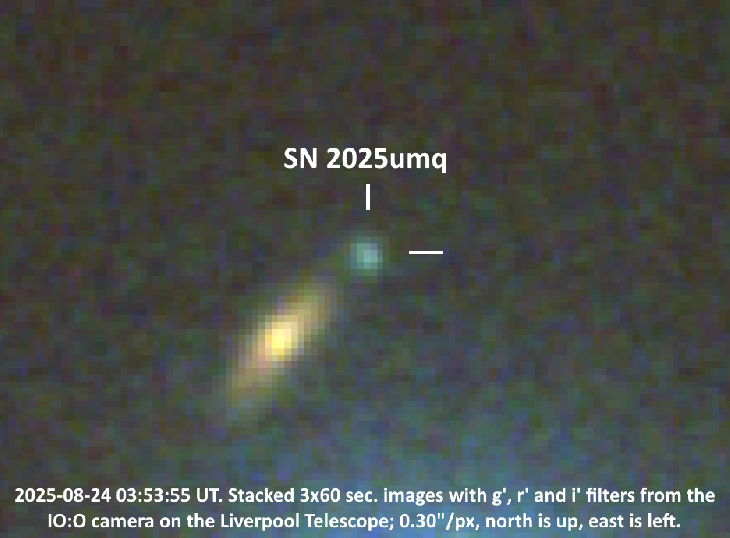
Click photo for larger image

| |
Camera Used: Unavailable Unavailable
Exposure Time: Unavailable
Aperture: Unavailable
ISO: Unavailable
Date Taken: Unavailable
|
|
More images
Details:
On August 17, 2025, on the 16th anniversary of the start of my study of astronomy by self-education, I made calculations of the sky coordinates and requested shooting on remote telescopes (with parameters according to my calculations, for example, shutter speeds and number of images) to search for new astronomical objects. When I received and viewed one of the series of images, I found a star in them, which, upon checking in various information sources, turned out to be an already known supernova, but even such a find is unusual for me, because in several years of searching in images, I did not come across even a single known supernova.
When checking 5 photographs (of the sky region in the constellation Pisces) with exposures of 300 seconds taken on this date with another remote telescope, the 0.51-m f/6.8 reflector T59 of iTelescope.Net, which is located at the Siding Spring Observatory in Australia, at the very edge of the images (only 12 arcseconds from the edges of the frames!) I saw a relatively faint star (only about +20 mag), which was absent from the archival photographs: only the galaxy SDSS J004819.14+075856.8 was visible in them nearby. I assumed it was a supernova in this galaxy, and when I checked, this star was unknown, so I measured its position and brightness, then sent the information to the Transient Name Server (as of January 1, 2016 the Transient Name Server (TNS) is the official IAU mechanism for reporting new astronomical transients such as supernova candidates) with the status as a possible supernova, and it was published there: https://www.wis-tns.org/object/2025umq with temporary designation AT 2025umq, and as PSN J00481888+0759006 on the CBAT TOCP http://www.cbat.eps.harvard.edu/unconf/followups/J00481888+0759006.html
On August 19 I made remote observations of this star with a two-metre-aperture robotic Liverpool Telescope (LT — on the Canary island of La Palma) to confirm the reality of the object, and it worked out, I also made new measurements of its position and brightness (to refine them): about +20.3 mag. On August 23 and 24 I additionally made photometric observations with the LT to get more such information about this star. I am attaching a photo (color) for August 24 (stacked 3x60 sec. with g’, r’ and i’ filters, 9 frames in total).
On August 20, according to my calculations and request, the spectrum of this star was obtained at the Liverpool Telescope, as a result of its analysis, this star was classified as a fading Type Ia supernova at redshift of 0.159 in the galaxy SDSS J004819.14+075856.8, with assignment it the designation SN 2025umq. On August 27, the corresponding ATel #17361 https://www.astronomerstelegram.org/?read=17361 was published on the website «The Astronomer's Telegram» about the discovery, photometry and classification of this supernova with my name as the first author.
I will add that later I saw in one of the scientific sources on the Internet that this supernova was previously detected by ZTF sky survey (the light curve shows a maximum brightness of about +20 mag around August 10, and the first detection was on July 25), but for some reason information about it was not sent to the TNS, so I am its official discoverer.
It is important that this is the first supernova discovered by me personally (in the images obtained - at my request - from a remote telescope), because earlier I discovered two supernovae SN 2022bsi and SN 2022jhn only in the images of the CRTS sky survey, participating in the supernova search project, so I am the first co-author of those discoveries. In addition, I consider it's luck that supernova SN 2025umq was not outside the boundaries of the images, because it was very close near the edges of the frames. Also note that those two supernovae were much closer (at redshifts of 0.0369 and 0.013) to our galaxy, while this supernova is distant enough: it has a redshift of 0.159, which means it is more than 2 billion light years away, so it was a big luck that I, an amateur astronomer, was able to discover so low brightness supernova! I should add that usually such faint supernovae are rarely classified using the Liverpool Telescope (because too long exposures are needed to obtain a good signal-to-noise ratio, so it is more practical to use larger telescopes, but I did not have the opportunity to use a larger telescope to study this supernova, so I tried to do it at the Liverpool Telescope), but in this case it was possible to do so with the LT - due to the sufficient distance of this supernova from the center of the host galaxy.
Now I am the discoverer (only on the basis of self-education) of 82 variable stars, 10 planetary nebula candidates (and co-author of discovery of 5), 3 supernovae (two co-authored and one personally), 4 probably physical binaries pairs of stars, 3 novae in M31; 3 transients (possible supernovae) and 8 asteroids; author of scientific papers in astronomy, which were published in scientific journals (including peer-reviewed) and co-author of the papers, for example, the most recent «GOTO065054+593624: An 8.5 mag amplitude dwarf nova identified in real time via Kilonova Seekers» was published https://doi.org/10.1051/0004-6361/202553823 in Astronomy & Astrophysics (A&A). I have given online presentations during several international conferences in astronomy, for example, e-Poster during the XXXIst General Assembly of the International Astronomical Union (IAUGA 2022), my paper "The contribution of the modern amateur astronomer to the science of astronomy" (based on this my e-Poster) was published https://arxiv.org/abs/2212.12543 in arXiv.
Photographer's website:
https://www.astronomerstelegram.org/?read=17361
|
|
|