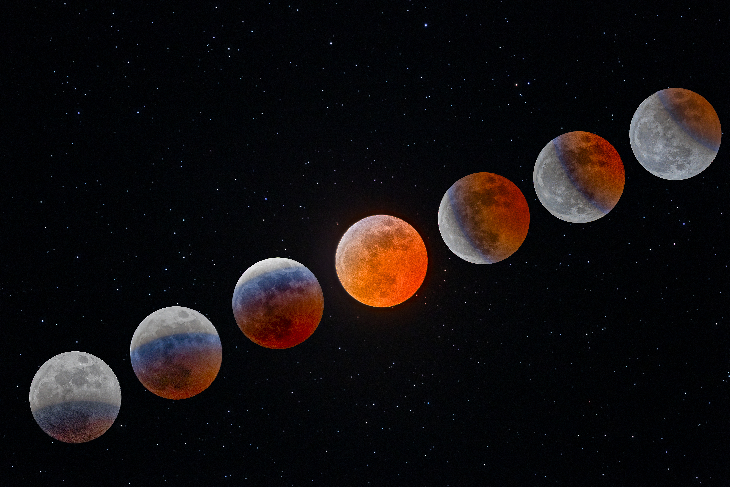
Moon eclipse
Taken by Maciej Libert on March 13, 2025 @
Pahrump, Nevada, USA
Click photo for larger image

| |
Camera Used: Canon Canon EOS R6m2
Exposure Time: 1/15
Aperture: f/8.0
ISO: 1600
Date Taken: 2025:03:25 05:50:16
|
|
| More images
Details:
I have been working on a composite image of the recent total lunar eclipse, where the partial phases are HDR images consisting of five different exposure times. While processing the image, I noticed something striking for the first time—the distinct blue transition at the edge of the Earth's shadow, where the penumbra transitions into the umbra.
Although I had seen similar images before, I never paid much attention to this phenomenon. But now that I captured it myself, I started wondering: Is this color real?
It turns out that this blue hue is real and caused by atmospheric scattering. While short-wavelength blue light is usually scattered away and does not reach the Earth’s shadow, some of it remains visible at the boundary of the umbra. The ozone layer plays a crucial role in this effect, as it absorbs parts of the red light, making the blue tint more prominent in this transition zone.
This effect is not always equally strong, as it depends on atmospheric conditions and light refraction during the eclipse.
Photographer's website:
https://www.facebook.com/maciej.libert
|
|
|