Mars Occultation Series
Taken by Alan Dyer on January 13, 2025 @
near Gleichen, Alberta
Click photo for larger image

| |
Camera Used: Canon Canon EOS R5
Exposure Time: 1/100
Aperture: f/1.8
ISO: 100
Date Taken: 2025:01:14 13:46:17
|
|
| More images
Details:
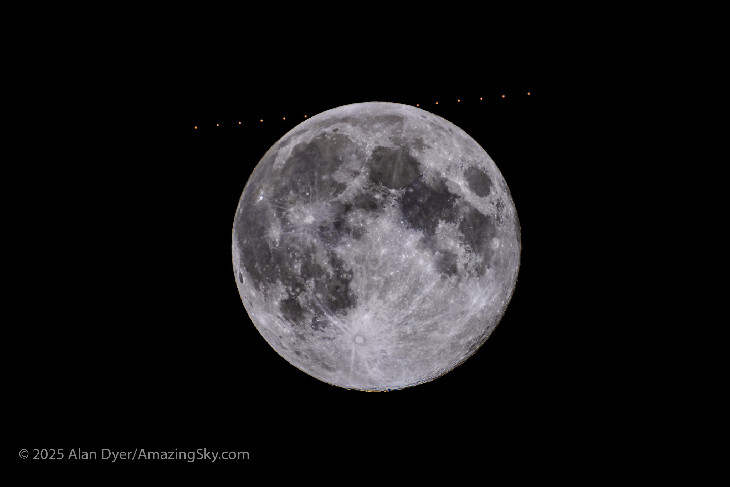
This is a composite sequence of the Full Moon passing in front of (occulting) Mars on the evening of January 13, 2025.
The Moon was officially Full only about four hours before the occultation, and Mars was two days before it was at opposition, and a day after it was closest to Earth since 2022. A similar coincidence of an occultation when Mars was also at opposition occured on December 7, 2022. I shot a similar sequence with the same equipment at that time.
On this night my location in southern Alberta was near the northern limit of the occultation zone, so Mars passed behind the northern limb of the Moon in a short chord. The occultation lasted only 20 minutes from my site in southern Alberta. From only 100 km farther north Mars would have grazed across the northern edge of the Moon, and from farther north the Moon would have missed Mars.
I shot still images at 5-minute intervals before and after the occultation, then 4K movies (not used here) at the actual disappearance (ingress) and reappearance (egress) of Mars. Time runs from left to right — the first image taken at 7 pm MST is at left; the last image taken at 8:10 pm is at right.
While it looks like Mars is moving behind the Moon from left to right, it is really the Moon moving from right to left (west to east) that is creating the occultation, a motion due to its orbital revolution around Earth. But for this sequence the telescope was tracking the Moon and keeping it centred.
The "seeing" conditions were quite poor, so atmospheric turbulence blurs the disk of Mars, making its north polar cap barely visible on the sharpest images.
Technical:
This is a blend of 12 exposures, each at 1/100 second at ISO 100 with the Canon R5 on the Astro-Physics 130mm refractor with a 2X Barlow for an effective focal length of 1560mm. The Moon is from a single image taken at the end of the series, and each Mars disk is also just a single image, layered onto the lunar disk base image but with the Moon masked out to reveal just Mars. Each image is unique and taken at the stated interval — I didn't just copy and paste the same Mars image to "recreate" the sequence!
The lunar disk is processed for high contrast to bring out the subtle variations in tone and colour across its disk and in the dark lunar "mare" or lava seas.
Photographer's website:
https://amazingsky.com
|
|
|