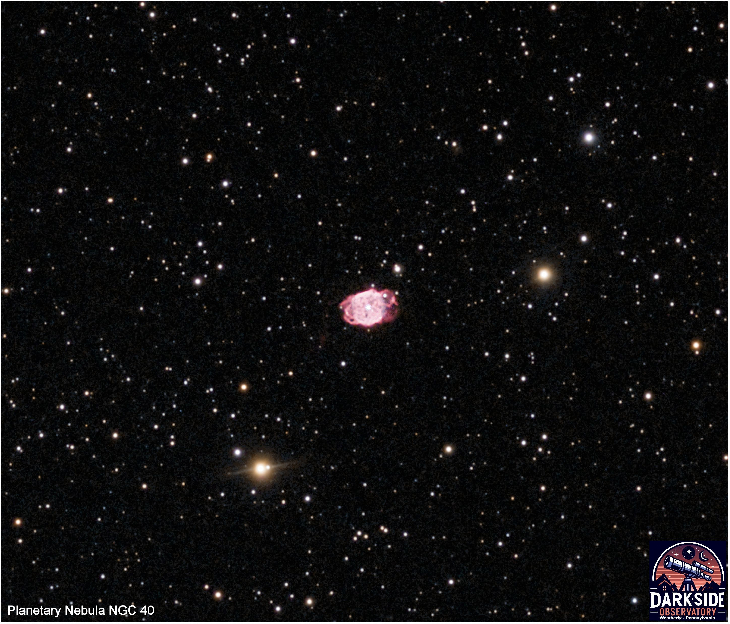
Planetary Nebula NGC 40 Bow-Tie Nebula in Cepheus
Taken by Thomas Wildoner on August 25, 2024 @
Weatherly, PA, USA
Click photo for larger image

| |
Camera Used: Unavailable Unavailable
Exposure Time: Unavailable
Aperture: Unavailable
ISO: Unavailable
Date Taken: 2024:08:31 15:43:31
|
|
| More images
Details:
NGC 40 (also known as the Bow-Tie Nebula and Caldwell 2) is a planetary nebula discovered by William Herschel on November 25, 1788, and is composed of hot gas around a dying star. The star has ejected its outer layer which has left behind a small, hot star. Radiation from the star causes the shed outer layer to heat to about 10,000 degrees Celsius and become visible as a planetary nebula. The nebula is about one light-year across. About 30,000 years from now, scientists theorize that NGC 40 will fade away, leaving only a white dwarf star approximately the size of Earth. (ref: Wikipedia)
Observation data: J2000 epoch
Right ascension: 00h 13m 01.015s
Declination: +72° 31′ 19.08″
Distance: 1,619 pc
Apparent magnitude (V): 11.6
Apparent dimensions (V): 38″ × 35″
Constellation: Cepheus
Designations: Bow-Tie Nebula, Caldwell 2, PN G120.0+09.8
Tech Specs: Sky-Watcher Esprit 120ED Telescope, ZWO ASI2600MC camera running at 0F, 81 x 60 second exposures, Celestron CGEM-DX pier mounted, ZWO EAF and ASIAir Pro, processed in DSS and PixInsight. Image Date: August 25, 2024. Location: The Dark Side Observatory (W59), Weatherly, PA, USA (Bortle Class 4).
Photographer's website:
https://thedarksideobservatory.com
|
|
|