| More images
Details:
For the week starting Sunday, July 7th, Mercury (mag. -0.2) is at its highest for its current evening appearance. On July 21st it will be at greatest eastern elongation, but its altitude will already be dropping back towards the Sun. Below it Venus (mag -3.9) hugs the horizon, as it will until mid-December. In between them is the 1.1-day old Moon.
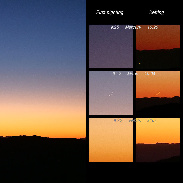
On Saturday evening I took a timelapse between sunset and when Mercury set and selected some frames to show in photo #1. Mercury and Venus in the primary image of #1 have been slightly enhanced to make them more conspicuous at a standard reading distance; finding the 4 pixels of Venus out of 20 megapixels would be impossible otherwise. The insets at the right are (crops of) unaltered 200% enlargements of the original frames; in particular, the primary frame and the Venus-set inset are the same photo, showing the appearance after and before processing, respectively. Mercury was also crossing the Beehive open cluster this evening, but although it set last in the darkest sky, it still wasn't night yet, and the sky remained too bright near the horizon to capture any cluster members.
Sunset was at 8:57pm MDT. The insets mark the times when each object was first definitively detected in the camera after sunset, and just before they set; the times also closely match the first view of them in 7x35 binoculars. Venus never became visible to the naked eye, lost in the solar glare, but Mercury became briefly visible once it got dark enough and before horizon extinction took it away again.
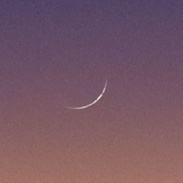
The new Moon's crescent did become visible to the naked eye for about a half hour. Binoculars revealed its unique visage: the smile of a toothy, grinning jack o'lantern. Despite the crescent being hyper-thin, there were at least 5 dark patches on it (the teeth), with the rightmost "tooth" so dark it bit clear through the crescent. Consulting a moon map afterwards, the dark gap could have been Mare Marginis, but I can't be sure. The Moon-only photo (#2), a stack of 6 highly enlarged, consecutive frames, attempts to show the dark areas.
Photos:
#1: view after sunset and insets of some closeups
#2: the Moon highly enlarged with dark areas
Photo data:
Panasonic G9, Leica 12-60mm lens @ 30mm, photo tripod
... timelapse: 9:07-10:23pm MDT; cadence: 30 seconds
... Aperture priority, f/3.7, auto (1/400 -> 2.5 sec), ISO, ISO 800
... date: June 6, 2024 MDT
... time of: primary image: 9:35pm MDT; inset images: notated on the insets
... processed: Paint Shop Pro
Photographer's website:
No URL provided.
|