| More images
Details:
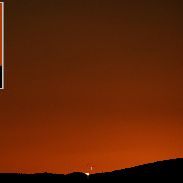
A timelapse was taken of Venus between the times of sunset and Venus-set (a span of 7 minutes), 6 days after its superior (far-side) conjunction with the Sun on June 4th. Shown is a composite of 3 individual frames: 2 show Venus about a minute from setting (spaced 20 seconds apart), and 1 shows where the Sun set 7 minutes earlier. (To be clear, Venus was 1-3/4° to the upper left of the Sun, set 7 minutes after the Sun did, and almost but not quite rode its path down to the horizon.)
I won't deny it, Venus was invisible during most of the timelapse until the last few frames before Venus-set, presumably due to glare and unsteady seeing at the horizon, but in those 7 minutes the exposure level dropped by 4 stops (I let the camera compute the exposure time), which was apparently just enough to let it start revealing itself, however tenuously. I'm sure you won't see it in the full FOV, but the inset (~500% enlargement) should work.
Curiously, in the inset it seems I can distinguish Venus more clearly by using averted vision rather than by looking at it directly. I don't understand that, since viewing on a computer screen should be plenty bright. Do others see that effect?
Photo data:
Panasonic GX8, Lumix 100-300mm lens @ 300mm, tripod
... timelapse with frames taken every 10 seconds from sunset to Venus-set (a period of 7 minutes)
... each frame Aperture Priority: (f/8, 1/8000-1/1000 seconds, ISO 200)
... date: June 10, 2024, actual sunset time (due to mountains) = 8.43pm MDT
Photographer's website:
No URL provided.
|