| More images
Details:
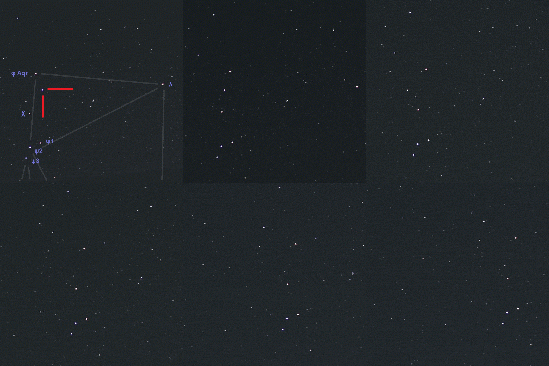
Near midnight (MDT) I was doing a little binocular observing with 7x35's when I spotted an anomalously bright star in the water jar of Aquarius. (Not the Y-shaped "Water Jar" asterism, but the area of the constellation with the water vessel he's supposed to be holding upright, marked by lambda, phi, psi, delta, and tau Aqr.) It was 3rd magnitude with no obvious movement. I had just completed a different camera-on-tripod project outside, so I swung it over and took a couple quick snapshots a minute apart of the area.
With 2 photos in hand I could see what was going on: the bright "star" stayed stationary at the frame's center while the real stars drifted ever so slowly by. Also, I remembered that the area was just south of the celestial equator, and the time of year was just past the autumnal equinox. What I had spotted was an unusually bright flare off a geosynchronous satellite that was plainly visible to the naked eye.
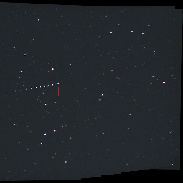
As I continued taking pictures the satellite began to fade as it entered Earth's shadow. Even so, the last frame taken ~20 minutes later still faintly showed it--maybe it was still in Earth's penumbra? During that time it traveled 5°. (5° x 3 = 15°/hr; 15 x 24hr = 360°/day--it checks out.)
#1: animated GIF of the satellite fading
#2: stacked image: red tickmarks mark 1st (right tick) and last frames (left tick) of the satellite over 20 minutes
Photo data:
Panasonic G7, Lumix 20mm lens, photo tripod
... early frames ~1 min apart, later ones ~2 min apart, timespan ~20 minutes
... 16 frames x (f/2, 10 sec, ISO 800)
animated GIF created at ezgif.com, stacking in Deep Sky Stacker, processing in Paint Shop Pro X2
Photographer's website:
No URL provided.
|