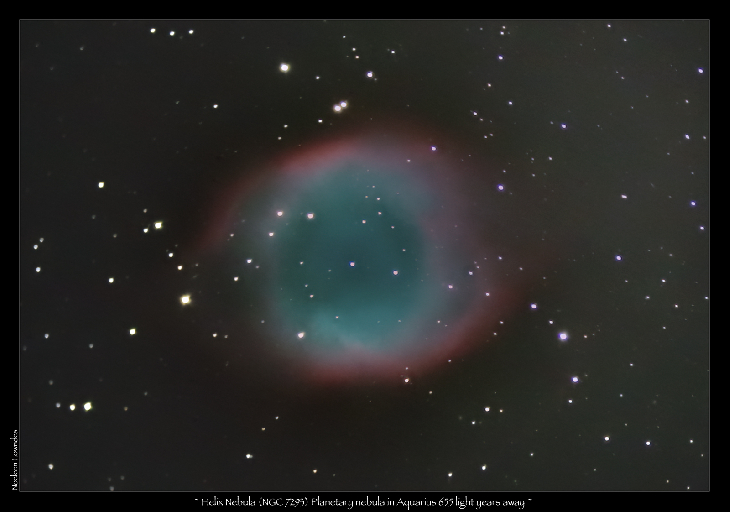
~ Helix Nebula ~
Taken by Noeleen Lowndes on September 18, 2023 @
Leyburn Qld Australia
Click photo for larger image

| |
Camera Used: Unavailable Unavailable
Exposure Time: Unavailable
Aperture: Unavailable
ISO: Unavailable
Date Taken: 2023:09:29 17:55:34
|
|
| More images
Details:
About 10,600 years ago a star like ours exploded and this is what it looks like today…awesome isn’t it, but there’s no need to worry as our life giving star still has 4.5 billion years to go ☺ ☺ ☺
The Helix Nebula (NGC 7293) was formed when a massive red giant star exploded, resulting in a white dwarf star forming at the nebula centre, expanding band of gases and dust can be seen surrounding the whole area as the star shed its outer layers into space.
The Helix Nebula is the closest planetary nebula to Earth and can be found very easily at the moment in a dark sky with binoculars or telescope in the constellation of Aquarius.
Image taken with Meade10inch LX200 Schmidt-Cassegrain telescope and Canon 6D Mark11 camera attached. 35X3 minute images captured with dark frames and ISO 2500, stacked in DSS and processed in PS.
Photographer's website:
https://www.mystardustobservatory.com
|
|
|