Polaris rotation during Solstices and Equinoxes
Taken by Marcella Giulia Pace on September 23, 2023 @
Sicily-ITA
Click photo for larger image

| |
Camera Used: NIKON CORPORATION NIKON D750
Exposure Time: 1/25
Aperture: f/6.3
ISO: 100
Date Taken: 2023:09:20 19:21:24
|
|
| More images
Details:
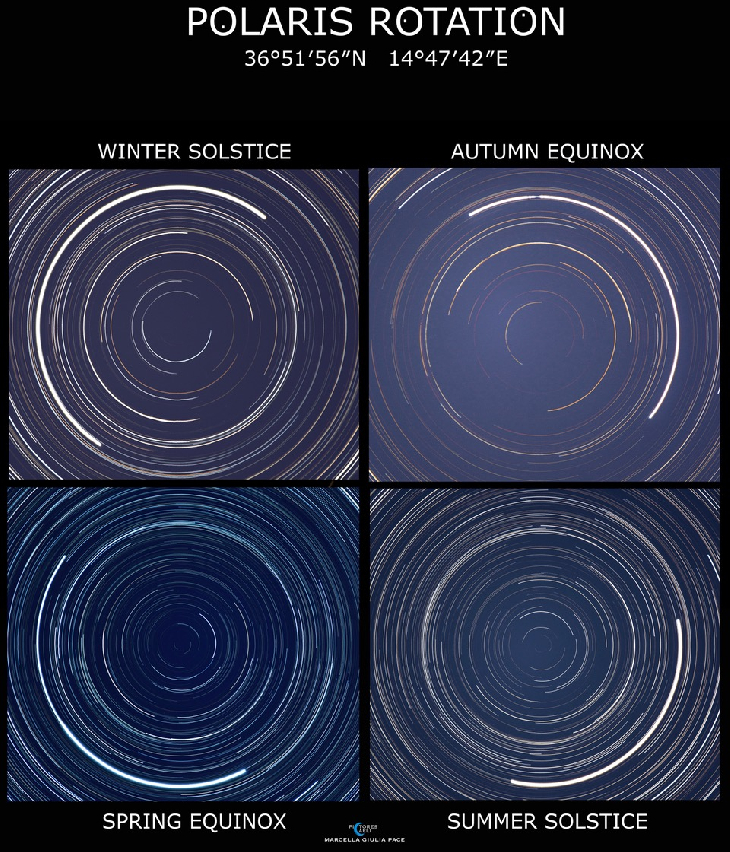
The Polaris does not coincide with the extension of the Earth's rotation axis and for this reason it rotates around the celestial North Pole
I wanted to tell the night of the solstices and equinoxes with the Polaris star from my latitude (Sicily-ITA).
I made the strar trails of the Polaris by photographing it throughout the night of
24/25 December 2022 (Vernal solstice)
19/20 September 2023 (Autumn equinox)
19/20 June 2023 (Summer Solstice)
16/17 March (Equilux)
The vernal (and autumnal) equinox occurs when the Sun crosses the celestial equator. In these moments, day and night should theoretically be of equal length, but in reality this is not exactly the case.
The reason is that, the sun is not a point but has a size and diameter that measures 32' This means that it is also necessary to take into consideration the expected time from the moment in which the lower limb of the Sun touches the horizon to when the upper limb of the Sun touches the horizon and this time is never even precise because the sunlight bends when it enters the earth's atmosphere, which causes the sun's rays to be seen a few minutes before it actually appears on the horizon and a few minutes after it has set. This phenomenon is known as atmospheric refraction.
For this reason, the Equilux, the moment when day and night are actually of equal length, occurs a few days before the vernal equinox. Equilux can vary slightly depending on latitude and geographic location, at my latitude it usually occurs a few days before the equinox.
For this reason I wanted to photograph the night of the Spring Equilux which corresponded precisely to March 16/17.
The autumn Equilux, however, will occur on the night between 26 and 27 September.
video with example of refraction on the sun: https://www.youtube.com/watch?v=c53SM22llHA
I started shooting during the hours of visibility of the polar: from the evening nautical twilight to the nautical twilight morning.
Nikon d7100 + 600mm; (intervalometer 27); F6.3 ISO100; t/25
Photographer's website:
https://greenflash.photo/portfolio/7045/
|
|
|