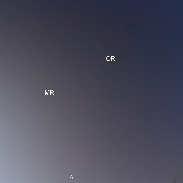
Bishop's Ring - Description
Taken by Doug Zubenel on August 7, 2023 @
Lenexa, Kansas.
Click photo for larger image

| |
Camera Used: Unavailable Unavailable
Exposure Time: Unavailable
Aperture: Unavailable
ISO: Unavailable
Date Taken: Unavailable
|
|
| More images
Details:
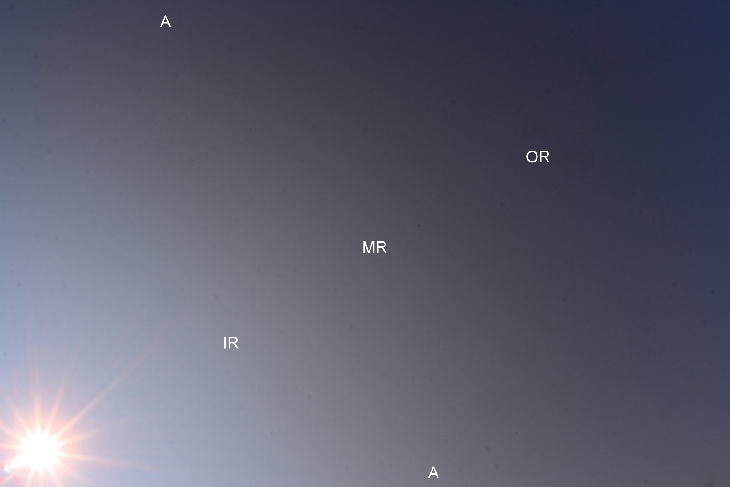
Yesterday, due to the smoke from Canadian wildfires covering the heartland, we had a Bishop's Ring, visible all day. Today, the conditions are nearly identical, and we have another Bishop's Ring in progress.
Following the 1883 eruption of Krakatoa, this type of atmospheric optic was first observed and described by the Rev. Sereno E. Bishop on September 5, 1883, and is here quoted from "Sunsets, twilights, and evening skies," by Aden and Marjorie Meinel (Cambridge Press, 1983) - "Permit me to call special attention to the very peculiar corona or halo extending from 20 to 30 degrees from the sun, which has been visible every day with us, and all day, of whitish haze with pinkish tint, shading off into lilac or purple against the blue. . . it is hardly a conspicuous object."
I made this image at 10:52 am, CDT, with a 16 mm NIKKOR-fisheye lens on a Hutech-modified Canon Rebel XTI body and a 1/160th second exposure @ f/22 at ISO 100.
The image shows you approximately what was visible to the naked eye using polarized sunglasses and a number 4 neutral density filter. IR, MR, and OR stand for the inner, mean and outer radius of the Bishop's Ring (being 30, 45 and 60 degrees respectively), while the two A's mark where the mean radius of the ring leaves the image frame at top and bottom.
The width of today's observed and photographed Bishop's Ring was 30 degrees. It is no wonder it is difficult to see, its size covers a lot of sky, and the coloration is pale pastel. Today, it appeared to be a yellowish-brown. The sky between the sun and the inner radius of the ring was a bright, pearly whitish-blue, while the color beyond the outer radius of the ring was normal blue sky coloration.
I agree with the Rev. Bishop that this is a very large corona, and not a "ring," per se, due to the inner bluish and outer brownish coloration characteristics. The "Halo," to me, is just the yellowish-brown portion, while entire corona includes the inner whitish-blue as well.
Photographer's website:
https://twanight.org
|
|
|