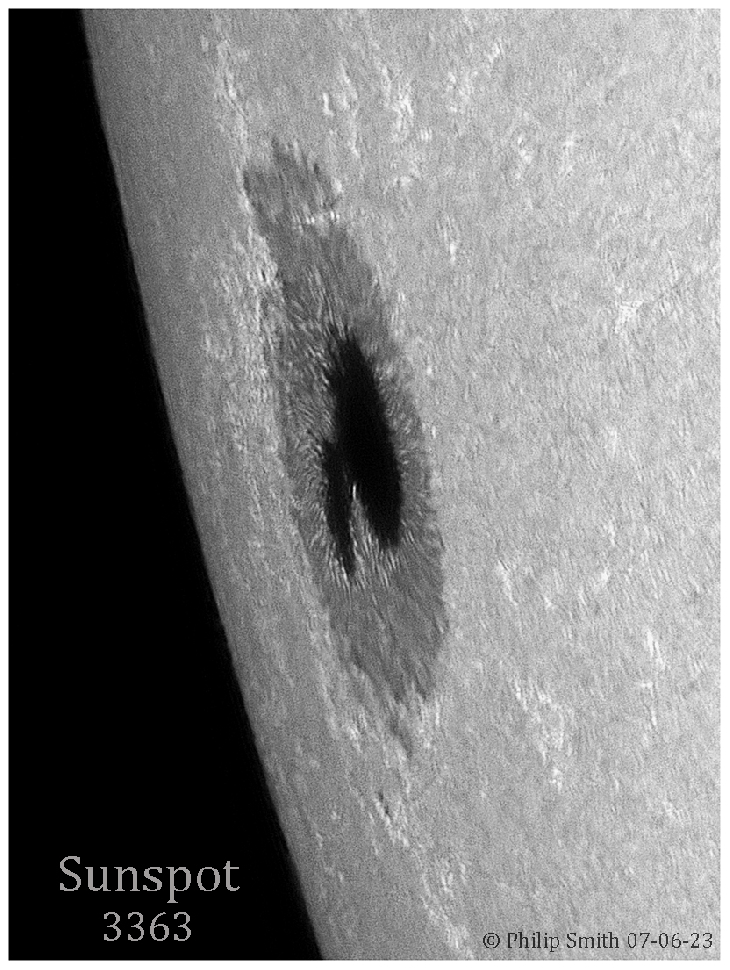
Sunspot 3363 On The Move
Taken by Philip Smith on July 6, 2023 @
Manorville, NY USA
Click photo for larger image

| |
Camera Used: Unavailable Unavailable
Exposure Time: Unavailable
Aperture: Unavailable
ISO: Unavailable
Date Taken: 2023:07:06 15:40:54
|
|
| More images
Details:
On 07-06-23 from my Manorville observatory, the large sunspot 3363. The average sunspot is about the size of the entire planet Earth! However, sunspots come in a variety of sizes ranging from hundreds to tens of thousands of miles across (many times larger that Earth). Scientists measure the total size (area) of all of the sunspots seen on the sun every day to get a measure of how active the sun is. Sunspots are not permanent. They appear and disappear on the surface of the Sun.
If you wanted to know what the Sun is made of. This is the answer: The Sun is a huge, glowing sphere of hot gas. Most of this gas is hydrogen (about 70%) and helium (about 28%). Carbon, nitrogen and oxygen make up 1.5% and the other 0.5% is made up of small amounts of many other elements such as neon, iron, silicon, magnesium and sulfur. The Sun shines because it is turning hydrogen into helium via the process of nuclear fusion in its extremely hot core. This means that as time goes on, the Sun has less hydrogen and more helium. For more about nuclear fusion and how the Sun shines, see Spitzer's IRrelevant Astronomy video
If you ever wanted to know how far away is the Sun.
The Sun is at an average distance of about 93,000,000 miles (150 million kilometers) away from Earth. It is so far away that light from the Sun, traveling at a speed of 186,000 miles (300,000 kilometers) per second, takes about 8 minutes to reach us. Like all of the other planets in our Solar System, Earth does not travel around the Sun in a perfect circle. Instead its orbit is elliptical, like a stretched circle, with the Sun just off the center of the orbit. This means that the distance between Earth and the Sun changes during a year. At its closest, the Sun is 91.4 million miles (147.1 million km) away from us. At its farthest, the Sun is 94.5 million miles (152.1 million km) away. The Earth is closest to the Sun during winter in the northern hemisphere.
Kind Regards To ALL 🙂
Photographer's website:
https://www.facebook.com/philip.smith.5686
|
|
|