| More images
Details:
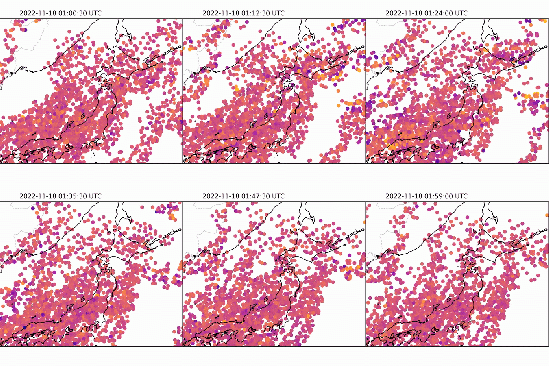
Ionospheric disturbances caused by an HSP-17 ICBM launched from North Korea on 18th November 2022 were investigated by using the GPS total electron content (TEC). The spatial characteristic of the front edge of V-shaped disturbances produced by missiles and rockets was first determined.
Key Points
• Clear V-shaped disturbance related a missile was found in GPS TEC
• The disturbance propagated faster than acoustic wave
Introduction
At a rocket or space shuttle launch, acoustic waves are generated in the atmosphere and lower ionosphere [Fehr, 1967]. Donn et al. [1968] attributed the generation mechanism to either the disturbances created by the gaseous exhaust stream or the object's supersonic motion. Based on GPS TEC observations, Calais and Minster [1996] found that the acoustic waves excited during the ascent of a space shuttle consist of a high-speed shock wave front and a series of low-speed oscillatory perturbations, and they explained the latter as guided waves that were excited by the shock front. Pulse-like shock fronts excited by rocket and space shuttle launches have also been reported based on observations using very long baseline interferometry [Li et al., 1994], Doppler sounders [Jacobson and Carlos, 1994], ionosondes [Arendt, 1971], and local GPS networks [Afraimovich et al., 2002]. These observations revealed acoustic waves characterized by horizontal velocities of 600–1670 m s−1 and periods ranging from tens of seconds to 10 min. A maximum propagation range of ~1500 km has been reported [Donn et al., 1968], although in the early days near-continuous observations of their full extent were not routinely obtained.
Recently, the two-dimensional (2-D) spatial variations of acoustic waves excited by ground-based sources such as earthquakes have been observed using densely distributed local GPS networks [Chen et al., 2011; Ogawa et al., 2012]. The wave structures that are excited by the supersonic movement of objects such as missiles and the Moon's shadow have also been analyzed [Liu et al., 2011; Kakinami et al., 2013]. Following the prediction by Chimonas and Hines [1970], that the movement of the Moon's shadow during a solar eclipse would excite a “bow wave” formed by acoustic gravity waves, Liu et al. [2011] used the densely packed local GPS networks of Japan, Taiwan, and the Republic of Korea to observe the acoustic waves generated during a total solar eclipse. They observed the fine structures of both bow and stern waves, which were believed to have been formed by acoustic waves with periods of 3–5 min and which traveled equatorward with a phase speed of ~1000 m s−1. Kakinami et al. [2013] used data from the same networks to analyze the ionospheric disturbances induced by a missile launch. They observed the front edge of V-shaped disturbances moving at a much higher speed than the speed of acoustic waves reported in previous studies.
In this study, we used GPS data organized by the Geographical Survey Institute of Japan (ftp://terras.gsi.go.jp/), the Central Weather Bureau of Taiwan (http://gdms.cwb.gov.tw/index.php), and the National Geographic Information Institute of the Republic of Korea (http://www.ngii.go.kr/en/main/main.do?rbsIdx=1). All data were recorded every 30 s. The slant TEC was calculated using the phase difference of two L-band (f1 = 1575.42 MHz and f2 = 1227.60 MHz) carriers emitted from GPS satellites. To estimate the observation bias in the TEC, the method employed by Liu et al. [1996] and Kakinami et al. [2009] was used.
Links
In the spirit of OSINT, the code is also open-source (though can be a bit finicky to run) https://github.com/tylerni7/missile-tid
The data for this test is from https://gsi.go.jp/ENGLISH/geonet
Background
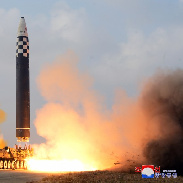
The new-type ICBM Hwasongpho-17, launched on 18th November 2022 at the Pyongyang International Airport, traveled up to a maximum altitude of 6 040.9 km and flew a distance of 999.2 km for 4 135s before accurately landing on the preset area in open waters of the East Sea of Korea.
The Hwasongpho-17 (화성포-17) is the largest road-mobile liquid-propellant missile ever designed and tested anywhere, so the North Koreans set a record of a sort with this successful flight-test.
Japanese MOD map of yesterday's North Korean missile launch is very close to my toy model. Slightly refined orbit of -6256 x 6100 km x 41.6 deg with impact near 137.2E 41.8N
Japan Mod confirms North Korea ICBM splashdown within EEZ after 69 minute flight (10:14 > 11:23 (01:14 >02:23 UTC)).
Commentary
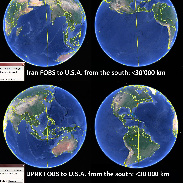
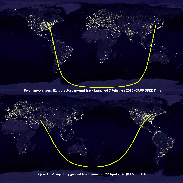
Preparations for developing FOBS weapons are so advanced, that rockets have been launched by both Iran and North Korea on several occasions, with trajectory heading similar to that of future FOBS missiles.
Indeed, both Iranian Safir-1 and Qased SLVs have placed payloads into orbit, while heading toward the U.S. mainland approaching from the south west.
Meanwhile, North Korean Unha-3 and Kwangmyongsong SLVs have placed payloads into orbit while approaching the U.S. mainland from the south east.
This might be consistent with a probable doctrine of coordinated Irano-Korean nuclear preemptive simultaneous saturation strike, conducted from multiple directions in order to defeat the U.S. missile defence system, and to maximize the probability of success.
Keeping in mind that the doctrine of first use of nuclear strike is inherent to the FOBS weapon, as then devised by the Soviet Union. Well, that is before Starlink (a.k.a. Star Wars/SDI 2.0) was even conceived.
Photographer's website:
https://web.archive.org/web/20221121174641/https://twitter.com/ArmsControlWonk/status/1593452159365918722
|