Mystery object of August 31st solved
Taken by Dr. J. Wayne Wooten on August 31, 2022 @
Pensacola, Florida
Click photo for larger image

| |
Camera Used: Unavailable Unavailable
Exposure Time: Unavailable
Aperture: Unavailable
ISO: Unavailable
Date Taken: Unavailable
|
|
More images
Details:
 |
NOT just seeing things.....
In my youth, I would often want to show my parents a faint galaxy or nebula with the 10" Starliner, but my father, perhaps with aging vision, would not be able to spot it, and mildly accuse me of averated imagination. This of course goes back to astronomers using the rods on the side of the retina for most sensitive B&W vision at night by not staring directly at an object, but putting it slightly off center, and picking up the faintest details with these regions. Our central cones are good at color vision, but not so accute to faint, low contrast sources.
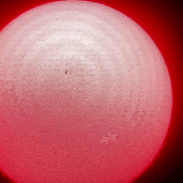
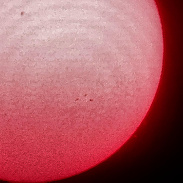
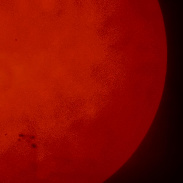
So when I go to the eyepiece of my Lunt on Monday morning, August 31, 2022 at 9:15 AM (14:15 GMT), I was amazed to see a dark region near the center of the Sun, almost as obvious at that moment as sunspot group AR 3089 to the lower right on the disk then. I naturally thought it was a new active region (it was, just VERY short lived, never even got a number...poor thing!) and so went in to post my iPhone 12s shots to Dr. Tony Phillips's Spaceweather.com gallery to alert others of its sudden appearance, for it was not on the SDO full disk visual image for that day. As I blew up the SDO image more, noted a tiny moon-sized pore just to west (left) of the dark flare, so decided to confirm with Eon 72 in visible light next. When I got back to the eyepiece of the Lunt at 10 AM, NO trace of my dark flare still there...was I seeing things! How could something far bigger than our Earth come and go so fast??? I did manage to capture the tiny pore spot with the Eon then, and posted my mystery to Spaceweather. Here is my original post, with the UT miscalculated (I am getting old).
https://spaceweathergallery.com/indiv_upload.php...
Not seeing any one else shooting my new AR, I tried pulling up GONG data, as suggested by Alabama Astrophotograher's Groups Steve Bacon. With help for the solar pros, here is my conformation...I am not crazy (yet).
ALEXEI PEVTSOV
Dear Wayne,
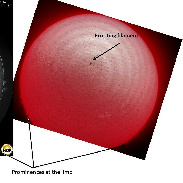
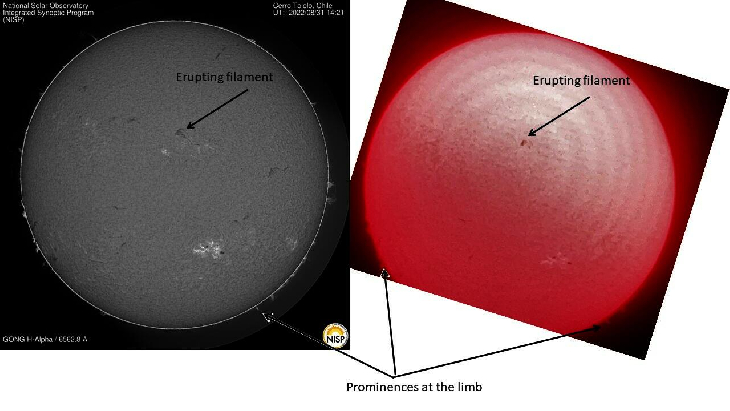
Thank you for contacting us about your observations. I think what you observed is an erupting filament. I am attaching a figure showing H-alpha observations from GONG at Cerro Tololo in Chile next to your H-alpha image from SpaceWeather.com site. I have to rotate your H-alpha image to align it with GONG data.
First, I believe that the UT time is shown incorrectly at
SpaceWeather.com site. (It was...getting old). By comparing with GONG observations, I can see that the best fit between your and GONG observations is at about 14:21UT (not 22:21 UT as SpaceWeather.com site says). I am using the location
of sunspots relative to solar limb for that matter.
Second, it appears that the bandpass of H-alpha filter used to take your image is offset across field of view. You can see it by comparing the appearance of solar limb in GONG and your images. GONG images show prominences off the limb everywhere around the Sun. In your image, you also see prominences, but only in the lower part of image. No prominences are present in the upper part of image. Based on this, I conclude that in your H-alpha image, the upper portion is taken with filter significantly off-band from H-alpha core.
During the eruption, the chromospheric filaments (which appear dark in solar disk) show significant Doppler velocity, which effectively shifts their appearance off-band from H-alpha core. I think this is why you see a dark filament material in your image during its eruption: the filter's bandpass is shifter in that portion of image, but the image of erupting filament is also shifted in the same wavelength direction.
As a demonstration of filament eruption, I created a video clip using GONG/Cerro Tololo observations between 12:00UT and 16:00 UT. The video is too large, for the email attachment, but you should be able to download JPG images I used for that video clip (as a zip file) from this link -
https://nispdata.nso.edu/.../NSO_NISP_174.16.50.239...
Total data size is: 98 MB
The archives of the files can be retrieved via HTTPS
I hope this helps explaining your observations.
Sincerely,
Alexei
--
Alexei A. Pevtsov, Ph.D.
NSO Associate Director
Director of NSO Integrated Synoptic Program (NISP)
National Solar Observatory, USA
Thanks, Alex!!! You are exactly right about the UT. Getting old. Indeed was 1415 UT when I set up the Lunt. Thanks for helping solve my mystery object! Love the portability of my Lunt 60 on the Virtuoso mount, but may need to upgrade to better solar scope. Looking at the new Baader Sundancer II on page 50 of the new October Astronomy that camer today!
Photographer's website:
https://www.facebook.com/groups/80860174301/photos/?filter=albums
|
|
|