| More images
Details:
Some stars travel through the skies under their own power while others let the world move around them. Here are stories about 2 of them.
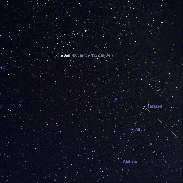
#1: rho Aql -- 30 years ago in 1992 this naked-eye star in Aquila next to a constellation border switched constellations. It did so by using its actual motion through space to physically move across the border from Aquila into Delphinus. Its apparent movement is slow, though, compared to that of Aquila's brightest star, Altair, that's much farther from the border but coincidentally moving in the same direction. Altair, being 10x closer to the Sun than rho (16 vs. 160 light-years), surely factors into this. Around the year 43000 Altair will close the gap and pass by rho 2° away and then leave it far behind. Rho will eventually clip the corner of Vulpecula between the years 58900-98000 before reentering Delphinus for a second time, where it stays put--constellation-wise--for the next couple hundred thousand years.
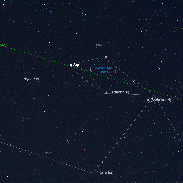
#2: eta Aqr -- On the night of Sep 4-5, 2022 the naked-eye star eta Aqr, the easternmost star of Aquarius' well-known "Water Jar" asterism that demarcates Aquarius' head, moves from south of the celestial equator to north of it. (Some sources say it already happened last month in August while others say it won't happen until early October.) In this case rho doesn't physically move--the Earth does. The celestial coordinate system denoted by right ascension lines (RA) and declination parallels (Dec) is determined not by the stars but by extensions of the Earth's polar axis and equator into the sky. The Earth wobbles like a top and takes its coordinate system with it. So, actually, every object in the sky is slowly but continually changing its coordinates at every instant over time. On this particular night the celestial equator inches south past eta, shifting the star's declination value from negative (south) to positive (north). If you look at zeta Aqr at the center of the Water Jar, you might wonder if the same thing happened there recently, and you'd be right: zeta went positive less than 20 years ago, in 2003.
Photo data:
Panasonic GX8, TTArtisan 50mm, iOptron SkyTracker v2
... #1: 7 x (f/4, 10 sec, ISO 1600) = 1 min 10 sec
... #2: 8 x (f/4, 20 sec, ISO 1600) = 2 min 40 sec
... N up (#1) or tilted 20° to right (#2), W clockwise. FOV = 20° x 15°.
Photographer's website:
No URL provided.
|