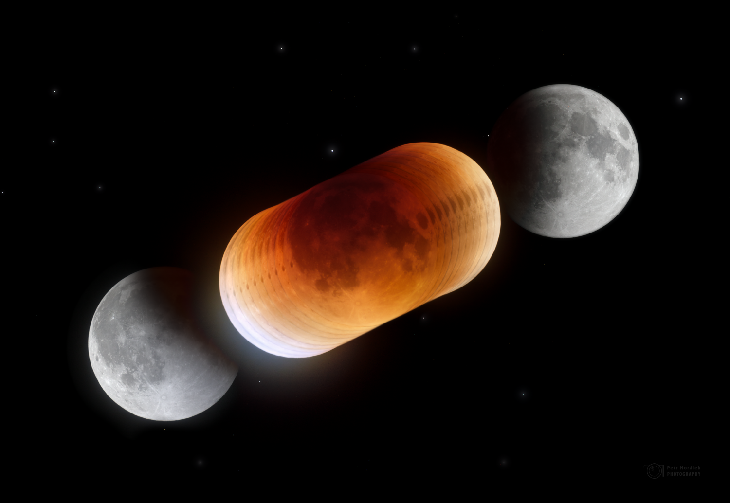
Colours in the Earth's Shadow
Taken by Josef Kujal, Petr Horálek/Institute of Physics in Opava on May 16, 2022 @
San Pedro de Atacama, Chile
Click photo for larger image

| |
Camera Used: Unavailable Unavailable
Exposure Time: Unavailable
Aperture: Unavailable
ISO: Unavailable
Date Taken: Unavailable
|
|
| More images
Details:
The total lunar eclipse on May 16th was pretty well expected as it could have been the darkest one after 1992-93 eclipses due to volcanic ash in Earth’s atmosphere, through which part of sunlight gets to the lunar surface. More ash in the atmosphere, darker eclipse we see. Eclipses in 90′ were affected by the Pinatubo eruption, while this year’s one is supposed to be darker because of the Tonga volcano. So I did a photographic investigation using the same exposures during the whole total eclipse (and unifying brightness of the exposures due to changeful clouds coverage during the phenomenon). Overall, the eclipse was not as dark as expected so far, but definitely interesting. As the image shows, the first half (right part) was definitely darker as the volcanic ash was thicker over the Indian and Atlantic Oceans than over the Pacific. Crook or Hook, what a wonderful eclipse it was! Used Canon 6D, MTO 1100, f10.5, ISO 800, 15s exposures (for totality; partial phase is HDR), tracked on Vixen GP-2. The co-author is Josef Kujal of the Astronomical Society in Hradec Kralove.
Photographer's website:
https://www.petrhoralek.com/?p=23045
|
|
|