| More images
Details:
I hadn't brought binoculars, but the camera's high-resolution electronic viewfinder gave a very satisfactory view of the crescent Venus. It was a lot brighter than I expected, and a lot fatter--viewing Venus that low must spread out its light quite a bit--but even so it was invisible to the naked eye.
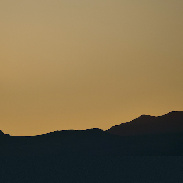
Photo #1: This shows the horizon profile and the distance in degrees between the setting sun and Venus. It's a panorama in space (3 300mm FOV's) and composite in time (22 minutes).
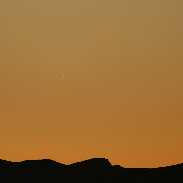
Photo #2: Venus's location when I first spotted it in the viewfinder at 5:47pm MDT. (On the computer later on I would find it in 2 or 3 earlier images that I hadn't noticed in the heat of the moment.)
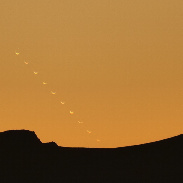
Photo #3: A 1:1-crop timelapse composite of Venus as it set. Frames were taken every 15 seconds, so the whole sequence is 2.5 minutes long.
Astro data:
Times listed are actual measured times. We have mountains here, so things set earlier than for an ideal horizon.
Jan 6, 2022
Sunset: 5:24pm MST
Venus set: 5:51pm MST
Photo data:
Panasonic G9, Lumix 100-300mm lens @ 300mm, photo tripod.
All exposures in P (program) mode.
For the timelapse itself the numbers work out to 10 frames x (f/5.6, 1/200 sec, ISO 400).
Photographer's website:
No URL provided.
|