| More images
Details:
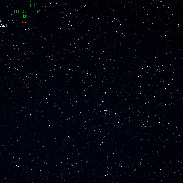
Sun night I was testing some equipment and finished about midnight. With the camera still on the scope I thought I'd take a quick photo of the nova field. After that I moved the scope to its "zero position" (pointing at the pole) to prepare for takedown, checked the photo, and there was the nova--easy peasy. So easy it made me wonder if I could still spot it visually. Alas, I made this decision a bit late--the fat gibbous Moon was rising. The robot scope could easily find the field of view again, but what was found in a photograph so readily was very hard to decipher in the eyepiece. By the time I was confident I knew which stars were which in the eyepiece the Moon was nearly 10° up and starting to blot out the sky--I couldn't see any stars dimmer than mag 12.0, and this included the nova. It looked brighter than the mag 13.1 comparison star in the photo, though.
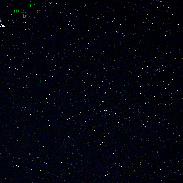
The photo has green tickmarks on the comparison stars and red for the nova. The numbers around the edges are arranged horizontally or vertically with the matching stars and are their magnitudes (in tenths). The faintest stars in the photo are mag 16-17.
Each thumbnail enlarges to a different size.
Photo data:
Panasonic G9, 5.5" Celestron Comet Catcher (500mm FL)
1 x (f/3.6, 1 min, ISO 1600)
Jun 28, 2021 ~midnight MDT (Jun 28, 6:00 UT)
N up, W right. FOV = 2° x 1.5°
Visual magnitude estimate:
between mag 12-13, probably nearer to 12
CCC at 71x in waning gibbous moonlight
comparison stars from SkySafari Pro 6 for the iPad
same date & time
Photographer's website:
No URL provided.
|