Mars+Sirius+Venus+Jupiter @day naked-eye
Taken by Giorgio Rizzarelli on September 15, 2020 @
Trieste, Italy
Click photo for larger image

| |
Camera Used: Unavailable Unavailable
Exposure Time: Unavailable
Aperture: Unavailable
ISO: Unavailable
Date Taken: Unavailable
|
|
| More images
Details:
(Click the picture for high resolution).
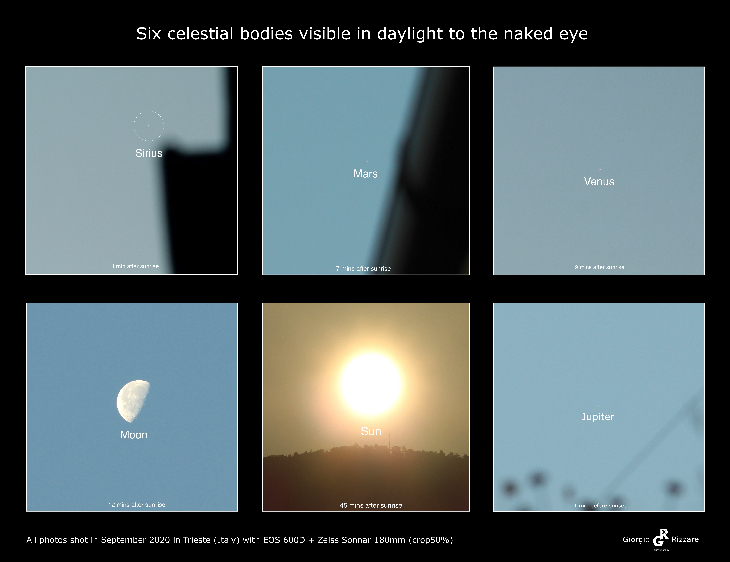
These days are a rare coincidence of favorable times to see in daylight (with Sun above horizon) with naked eye Jupiter, Mars, Sirius and Venus, plus of course Moon and Sun. These photos, shot about at same times when I saw the objects, try to convey the feeling of this live show and get you to try watching for yourself.
Sirius, Mars and Venus are currently visible in the morning, while Jupiter in the evening. The Moon is now in waning i.e. morning phase, next week it will be visible in the evening.
The morning bodies are easier: You can start at twilight when they're evident, and use some landscape objects (like chimneys, trees etc) to keep memory of their positions respect landscape while the sky gets brighter and the bodies slowly move across the sky (Sirius takes a morning with transparent air). The sunset one (Jupiter) is a bit tricky since you start at daylight, so you need to remember the position from a previous sunset (using a landscape object) and possibly use binos to find it, before trying with naked eye.
Here is the list of the bodies from the brightest, with the reason why the body is in favorable period, the magnitude, the magnitude reduced by airmass for objects that are low on horizon, and for how many minutes one can typically see the body in daylight with naked eye. The last two numbers depend on latitude, I report data for a mid latitude like mine (45°).
| Sun
| Moon
| Venus, at West respect Sun since months: mag -4, visible until 30' after sunrise
| Jupiter, near 2nd inversion: mag -2.5, reduced to -2 for low alt, visible starting 5' before sunset
| Mars, near 1st inversion: mag -2, visible until 10-15' after sunrise
| Sirius, near end of Summer: mag -1.5, reduced to -1 for low alt, visible until 0-5' after sunrise.
The ISS is also visible at day with naked eye if you have a lucky pass near sunrise/sunset.
Photographer's website:
No URL provided.
|
|
|