Moon
Taken by Howard Eskildsen on July 13, 2020 @
Ocala, Florida
Click photo for larger image

| |
Camera Used: Unavailable Unavailable
Exposure Time: Unavailable
Aperture: Unavailable
ISO: Unavailable
Date Taken: 2020:07:14 18:42:07
|
|
| More images
Details:
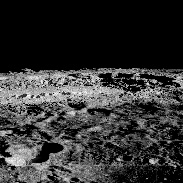
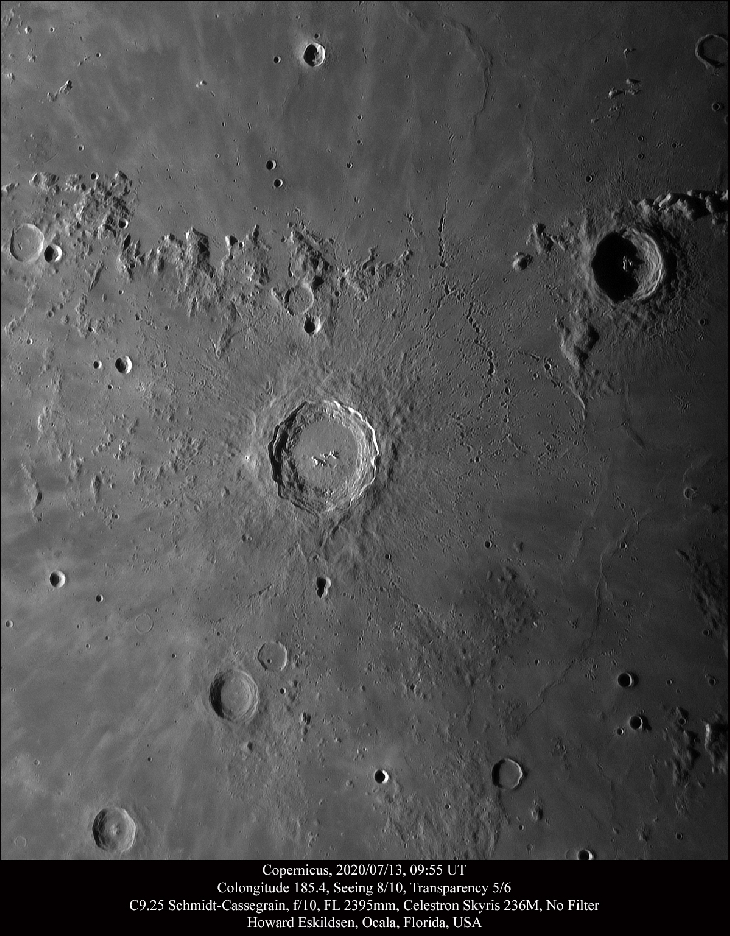
Two images of Copernicus are shown, one a telescopic view and the other taken by Lunar Orbiter in the 1960's. At first glance they give wildly different impressions of the crater. The telescopic view gives the impression of a slight depression surrounded by massive walls with hummocky slopes tapering into the surrounding area. The oblique orbital view, however, gives the feel of catastrophic collapse of the crater floor with minimal wall elevation surrounded by tortured terrain. It is almost as if they were two different craters.
Look closely, however. Craters Fauth, and Fauth A form a distinctive pair just south of the crater on both images. North of the crater, the largest mountain visible on the horizon of the orbiter view corresponds to the massif lying on the NE margin of crater Gay-Lussac. Also, the configuration of the central peaks confirm that they are indeed the same craters.
On the telescopic view, Gay-Lussac lies in the Montes Carpatus, and its namesake rille angles to the lower left of the crater. To the right of the image Eratosthenes embraces the end of the Montes Apenninus, and between it and Copernicus, secondary craters from the latter pock the flat basalt plains like a skirmish line. Pytheas is visible on the upper central photo. Domes are visible near the small crater Hortensius on the left margin to the lower left of Copernicus and by small craters Gambart C and B.
Copernicus is an amazing area of the Moon as seen from Earth and from orbit.
Photographer's website:
No URL provided.
|
|
|