Against the Sun
Taken by Filipp Romanov on April 29, 2020 @
Russia
Click photo for larger image

| |
Camera Used: Unavailable Unavailable
Exposure Time: 1/1000
Aperture: f/4.5
ISO: Unavailable
Date Taken: 2020:04:26 13:14:34
|
|
| More images
Details:
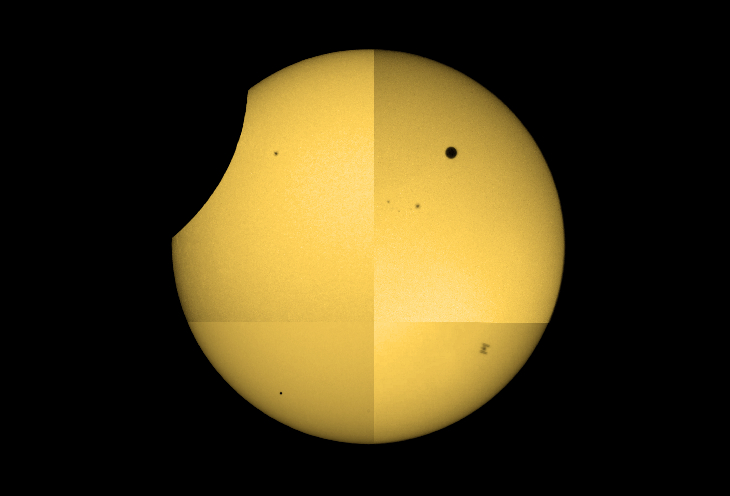
I made this image from photos taken in Russia.
Transit of Venus: from territory of Ussuriysk Astrophysical Observatory, in Gorno-Tayozhnoe, Primorsky Krai (June 6, 2012, 02:13 UT; exposure time: 1/1000 sec.);
ISS transit: from Livadiya, Primorsky Krai (June 24, 2013, 05:01 UT; exposure time: about 1/1000 sec.);
solar eclipse: from Korolyov, Moscow Oblast (March 20, 2015, 11:19 UT; exposure time: 1/3200 sec.);
transit of Mercury: from Moscow (May 9, 2016, 11:46 UT; exposure time: 1/100 sec.).
Equipment: filters from Baader AstroSolar visual solar safety film.
For transit of Venus and for ISS transit: Veber reflecting telescope, diameter 114mm, focal length 1000mm; camera Canon Digital IXUS 310 HS; through eyepiece 25mm.
For solar eclipse and for transit of Mercury: Sky-Watcher BK P2001EQ5 reflecting telescope, diameter 200mm, focal length 1000mm; camera Canon EOS 60D.
These single images were little processed by me (brightness, contrast and levels) in Paint.NET software. I cropped, resized and united photos in Paint.NET.
The weather was clear during all astronomical events, except for the transit of Venus: I waited a long time for gaps in the clouds, and only by the time of the middle of this transit the sky cleared (I was the first of the people at the observatory who photographed this transit). From 2012 to 2016, I photographed the transits: of Venus and of Mercury, solar eclipses and transit of the ISS across the Sun. Each of these objects covered part of the solar disc. I decided that it would be very interesting to visually see the comparative angular sizes of all these objects against the background of the Sun so I did this photo work - composite image. I deliberately left edges, because these astronomical events can't be seen together, and this would have looked unnatural. This shows that with coincidence of circumstances, for 4 years it was possible to observe all these astronomical events, because the next transit of Venus across the Sun will be only in the 22nd century, when and the ISS probably will no longer exist.
This my photo work "Against the Sun" has been honorary mentioned in AstroCamera2020 Competition (received jury rating "Honorary mention") https://www.hevelianum.pl/news/606_konkurs-astrocamera-2020-rozpoczety- in Category II (Solar System objects).
Best regards,
Filipp Romanov (23 years old, amateur astronomer since
2009, discoverer of variable stars and planetary nebulae candidates,
possible double stars and transients, author of two scientific papers
published in scientific journals
https://filipp-romanov.livejournal.com/27664.html ).
twitter.com/romanov_filipp
instagram.com/romanov_filipp
Photographer's website:
No URL provided.
|
|
|