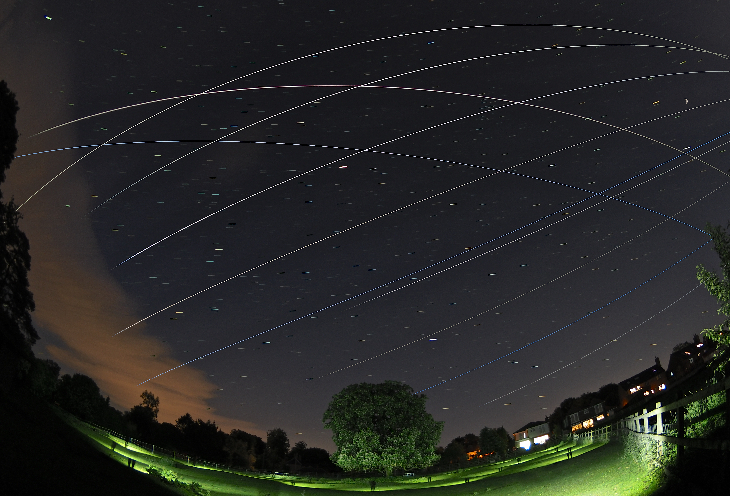
International Space Station
Taken by Mark Humpage on May 30, 2020 @
Cotesbach, Lutterworth, Leics, UK
Click photo for larger image

| |
Camera Used: OLYMPUS CORPORATION E-M1MarkIII
Exposure Time: 15/1
Aperture: f/3.5
ISO: 500
Date Taken: 2020:05:19 22:52:17
|
|
| More images
Details:
The end of May brings to a close an extraordinary month of International Space Station (ISS) passes over UK skies. We have also been blessed with clear skies (most of the time!).
We finished off the month with a stunning SpaceX live launch, yesterday on 30th May as two astronauts made their way to an historic meet with the ISS today!
To celebrate and close this marvellous Space May month I set out to create an ISS extravaganza. It is a multiple exposure of all the (clear sky) ISS passes starting on 19th May and finishing last night on 30th May. I didn't get clear skies every night, unfortunately (that would have been really nice!) but I have managed to capture 11 passes, shown as a multiple composite in a single image.
How did i do this?
Firstly the gear:
Olympus OM-D, EM-1 mk3
8mm fisheye lens (4/3)
Tripod (located in same position in field for 2 weeks!)
So the first part of the planning was to choose a location in the field, at home, which would allow a good west to east horizon composition. It was set to point due South,
The next step was to capture as many ISS passes for the remaining 2 week period as possible, clear sky permitting. All the dates and times were pulled from the Heavens Above website (or app) - https://www.heavens-above.com
Each ISS flyby I will call a batch. For the first ISS pass on 19th May (2255hrs) the camera was set up on the tripod and I waited until the ISS passed overhead. I had a few trial runs for each batch to ensure settings worked.
The setting I used :
f3.5, ISO320 - 500 (depending on how light the sky was) and exposure times were 15s max (down to 3s, again depending on how light the sky was).
For each ISS pass a number of long exposures - approx 15-20 were taken (or batch) which covered the entire flyby. I had to set up and take down the camera using the fixed tripod for each pass, each day.
To capture each batch of images I used the Olympus in-camera 'Live Composite' mode. This very handy facility captures each exposure and automatically stacks to produce a final composite image.
I used this Live Composite mode for every single ISS pass (batch).
Unfortunately cloud killed visibility for a few days but on the whole it worked out well. The following days/passes were captured:-
19th May - 2255 hrs
20th May - 0032, 2207 & 2344 hrs
22nd May - 2345 hrs
24th May - 2346 hrs
25th May - 2259 hrs
27th May - 2300 hrs
28th May - 2212 hrs
29th May - 2300 hrs
30th May - 2213 hrs
Quite a marathon eh! Lockdown and home stay certainly allowed me to run this marathon!
Once I had captured the 2 weeks of images (batches) I brought them all together for post-processing. The first pass on the 19th was used as the baseline exposure (and where the ghostly shadows were added - me walking around field with a torch on/off during the flyby) with all other passes (batches) added as a multiple exposure. Some slight tweaking with the alignment (but not much) due to weather/wind and continually taking camera on/off tripod.
The final image you see is a single image Multiple Exposure of ISS passes from 19th-30th May 2020. For info the reason there are differing colours tones to each ISS pass is down to the brightness and time of the pass. Early evening passes had lighter skies and post processing involved masking each layer only to show the ISS trajectory pass.
It's fascinating to see the different trajectories as this wonderful piece of science flies unassuming over our heads each cycle. The next set of UK passes in July :-)
Now I rest....phew.
Photographer's website:
https://www.markhumpage.com/Mother-Nature/Sky-at-Night/
|
|
|