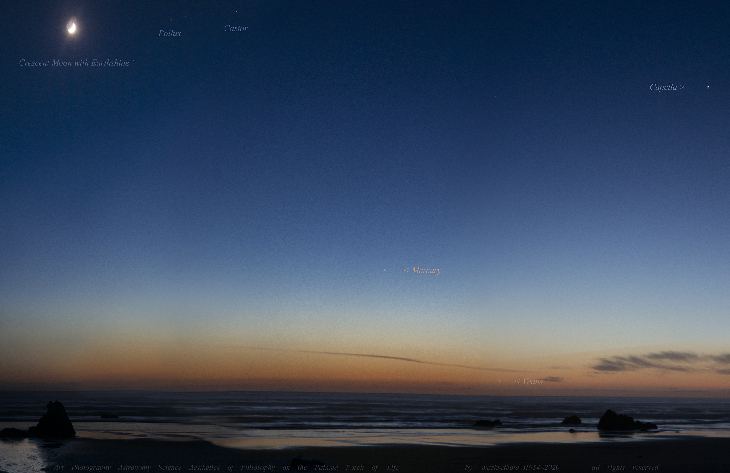
Crescent moon with Earthshine, Mercury [and Venus through a telescope]
Taken by Mark Seibold on May 25, 2020 @
Cannon Beach Oregon
Click photo for larger image

| |
Camera Used: Unavailable Unavailable
Exposure Time: Unavailable
Aperture: Unavailable
ISO: Unavailable
Date Taken: 2020:05:27 19:46:19
|
|
| More images
Details:
Eye visible viewing guide version - with celestial objects labeled for your convenience -
Most people will never see the planet Mercury - Now is that time to see it, but remember it will always be in a twilight sky and never dark skies.
The scene will not have changed that much by tonight Wednesday May 27th 2020 - The Moon will appear a little higher in the southwest and slightly fuller in crescent phase, and Venus will appear as a slightly lower near the horizon. You must be ready to observe by nor later than sunset - as this entire scenario will be observed in virtual twilight, {still daylight,} and not after dark.
Venus, Mercury, and Crescent Moon Naked Eye Visible at After Sunset in Western Sky From Tolovana Park Cannon Beach - Sony NEX 5R Panormama Photo-stitch 5614x
art & photography by markseibold©1954~2020
all rights reserved
Venus in fast decreasing crescent phase May 26th 2020 from Tolovana Park Cannon Beach.
A Sony NEX 5R was tripod mounted over a Meade Super Plossl 32mm eyepiece producing 39x magnification, with a Celestron Nexstar 5i Cassegrain with equatorial tracking. The planet was low on the horizon over the ocean through atmosphere and clouds, as the distortions degraded the image considerably.
This near circle of light in seen to be enwraping Venus's circumference, and was more so noted as observed in live real time observation through the telescope eyepiece.
*Yet the thin crescent is visible here, but more so the continuous atmospheric lighted circle of Venus' disc this when visible. It is much more difficult to photograph this event than it is to simply observe it, during this very short window of opportunity. To photograph it this must be attempted when the planet is the highest above the Horizon as possible. It is actually more attainable to photograph this event when the planet is still in daylight with the sun still above the horizon. So there are several conditions to be met which are difficult to manage, due to the constraints of the sun's intense light still being above the horizon. This can still be achieved in the next few evenings, but it becomes increasingly difficult as the planet nears the proximity of the sun's direct light in the sky. Needless to mention the dangers which must be advised against. As astronomers we are required to inform the public to never look directly at the sun's disk through concentrated optics, which are not properly filtered to view the sun safely.
The first time I've ever witnessed this. Tonight on May 26th 2020 I'll observe this again, from Portland this time, and possibly allow others to experience this live as observed through the telescope tonight, from a high hilltop somewhere in the Portland metro region.
Technical: Agressive processing was used to render the most details, although this also raised visual noise considerably.
art & photography by markseibold©1954~2020
all rights reserved
* I apologize for my earlier post, as the text was not edited and grammatically corrected for typos. Also the images were not ideally sized for easily viewed display.
Photographer's website:
https://Facebook.com/mark.seibold
|
|
|