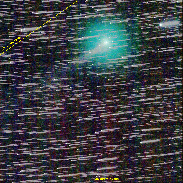
C/2019 Y4 ATLAS
Taken by Hisayoshi Kato on March 26, 2020 @
Akagiyama Gunma Japan
Click photo for larger image

| |
Camera Used: Unavailable Unavailable
Exposure Time: Unavailable
Aperture: Unavailable
ISO: Unavailable
Date Taken: 2020:03:28 21:48:04
|
|
| More images
Details:
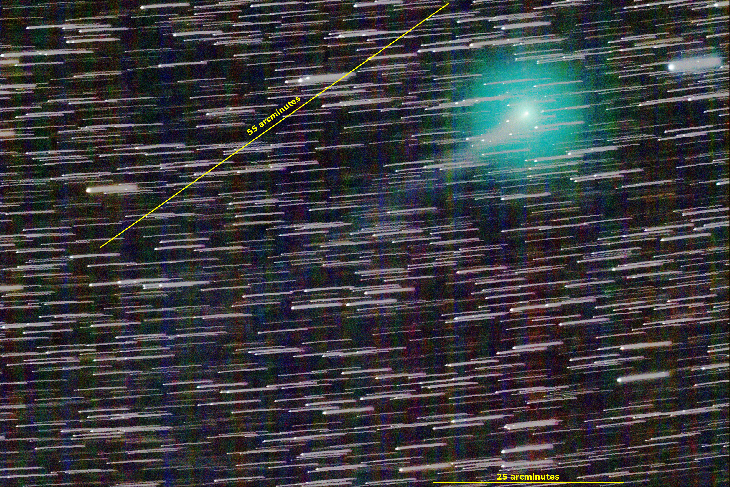
The bluish ion tail looked very long on this enhanced dirty frame.
The comet was drifting fast toward west a bit northward in Ursa Major. Whitish coma was round and got bigger and brighter compared to that 6 days before. The diameter of whitish coma was about 4 arcminutes. Whitish tail got longer toward southeast, and bluish ion tail got far longer around 55 arcminutes. Two streams were visible in blue and green channels. Bluish Green ion coma was bigger around 25 arcminutes in diameter including the faintest detectable part at the night. The diameter was bigger about 26.5 arcminutes on March 18, 2020. North is up, and east is to the left.
equipment: Takahashi FSQ130ED and Canon EOS R-sp4II, modified by Seo-san on Takahashi EM-200FG-Temma2Z equatorial mount, autoguided with Fujinon 1:2.8/75mm C-Mount Lens, Pentax x2 Extender, Starlight Xpress Superstar Autoguider, GPUSB, and PHD2 Guiding with comet tracking on
exposure: 17 times x 12 minutes, 1 x 4 min, and 5 x 1 minute at ISO 3,200 and f/5.0
The first exposure started at 11:46:34 March 26, 2020UTC, and the last ended at 15:29:34UTC. I could not complete my initial imaging plan again due to encroaching clouds. Last few shorter exposure frames were taken through thin clouds.
Frames rotated counter-clockwise by about 6 degrees while the equatorial mount followed the fast drifting comet for 222 minutes.
site: 1,498m above sea level at lat. 36 32 19 North and long. 139 11 06 East in Volcano Akagiyama in Gunma, Japan
Photographer's website:
https://www.flickr.com/photos/hiroc/49706433876
|
|
|