Bailly, Schiller-Zucchius Basins
Taken by Howard Eskildsen on January 9, 2020 @
Ocala, Florida, USA
Click photo for larger image

| |
Camera Used: Unavailable Unavailable
Exposure Time: Unavailable
Aperture: Unavailable
ISO: Unavailable
Date Taken: 2020:01:12 08:47:11
|
|
| More images
Details:
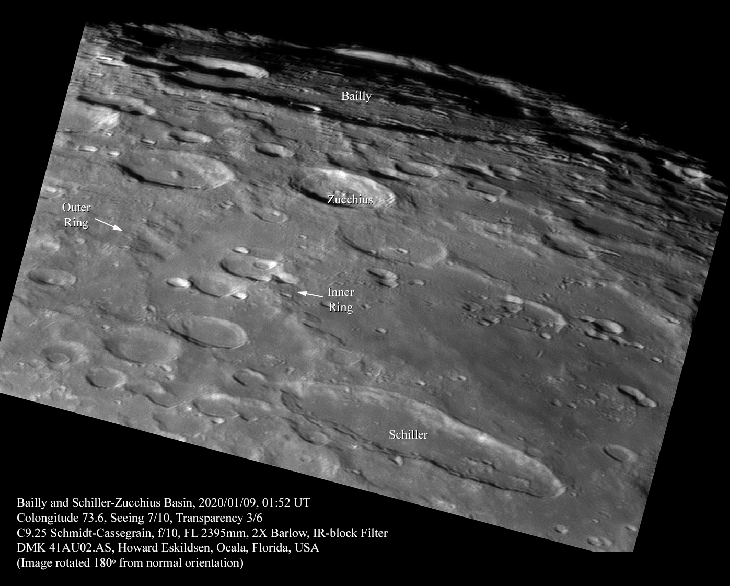
This image is oriented in the telescopic view (south up, east-west reversed) and shows the two impact basins, Bailly and the Schiller-Zucchius Basin. Bailly has been listed in the past as the largest impact crater on the Moon. Per page 293 of The Moon by Wilkins and Moore, it was described as "The largest of all the lunar ringed structures, the 'seas' alone excepted." It has a diameter of 303 km per the Virtual Moon Atlas (VMA) and the Atlas of the Moon by Rükl. However, it is now recognized as the smallest impact basin with a small, irregular inner ring of 150 km and outer ring 300 km (Table 4.1, page 64, of The Geological History of the Moon by Wilhelms, McCauley, and Trask). Hints of the inner rim can be seen on near the label "Bailly" on the image.
In contrast, the inner and outer rings of the slightly larger Schiller-Zucchius Basin (SZ), named for two nearby craters, are quite apparent and are marked by arrows on the image. This basin's outer ring diameter is listed as 325 km and inner ring 165 by Wilhelms while Chuck Wood's Impact Basin Database (https://web.archive.org/web/20110615073328/http://www.lpod.org/cwm/DataStuff/Lunar%20Basins.htm) lists a minimally larger size of 335km outer ring, and 175 km inner ring. Comparison of the two basins shows how the inner ring becomes more apparent with increase in size.
Schiller, located on the outer SZ ring, is an oblique impact crater 179km by 70 km in size and is described as " larger version of Messier" by Wood and Collins in the 21st Century Atlas of the Moon. It adds to the delight of this target of opportunity as the Moon nears full phase.
Photographer's website:
No URL provided.
|
|
|