Lunar Eclipse
Taken by project nightflight on July 16, 2019 @
Austria
Click photo for larger image

| |
Camera Used: Unavailable Unavailable
Exposure Time: Unavailable
Aperture: Unavailable
ISO: Unavailable
Date Taken: Unavailable
|
|
| More images
Details:
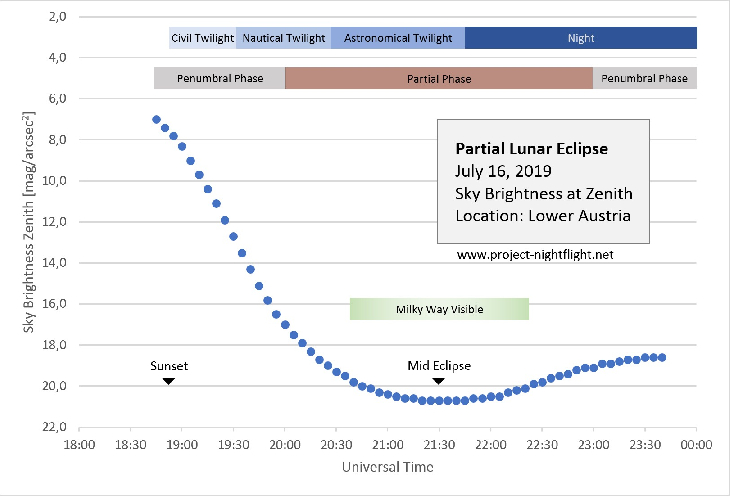
During the partial lunar eclipse on July 16 we experienced exceptionally clear skies at our observing site in Austria. We took the opportunity to make a series of measurements of the sky brightness in the zenith as the lunar eclipse progressed. We gathered 60 data points with an SQM-L sky quality meter every five minutes from sunset until well into the second penumbral phase.
Our goal was to find out the sky brightness value at which the Milky Way becomes visible to the unaided eye. The value we found out is at around 19.8 magnitudes per square arcseconds. At our location visibility of the Milky Way started at 20:38 UT and ended at 22:25 UT. We found that the Milky Way is visible when at least a third of the Moon was covered by the umbra. During that time the surrounding landscape turned very dark and it became hard to handle the instruments without the aid of additional lighting.
The chart shows the twilight phases, the eclipse phases, the sky brightness values, and the visibility of the Milky Way on July 16, 2019. The eclipse dip in the sky brightness is clearly shown. All measurements were made from a dark sky location near the Grossmugl Star Walk installation in Austria.
Photographer's website:
https://www.project-nightflight.net
|
|
|