Moon Apogee and Perigee
Taken by Nunzio Micale on February 20, 2019 @
Vieste, Italia
Click photo for larger image

| |
Camera Used: Canon Canon EOS 70D
Exposure Time: 1/800
Aperture: f/inf
ISO: 1600
Date Taken: 2019:02:19 22:14:39
|
|
| More images
Details:
In the last years, journalists call it Super-Moon, when the Moon in its full phase, lays at the closest point to the Earth. Although the prefix "Super" is scientifically mistaken or misunderstood as "huge", it fixes good to let people think about something "bigger" than usual. Moon orbit around the Earth is elliptical, therefore it has a closest point to our planet, best known as perigee, such as a farthest one, that is called apogee, on the contrary.
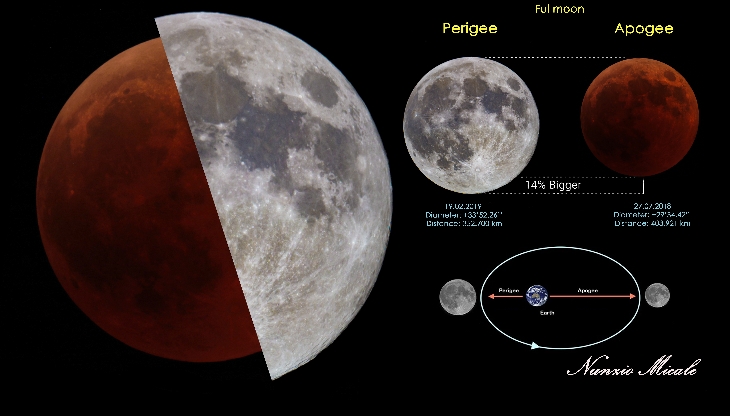
This picture shows a comparison between two shots. The "red" one was taken during the 27th July 2018 total Lunar eclipse which was actually the longest of this century. It portraits the Moon at its apogee when it was 404.000km far from the Earth surface. By contrast, the other one has been taken on 19th February 2019 and it is actually the famous "Super-Moon".There, the Moon is at its perigee, 352.700km far from Earth.
Photographically it is evident how the Super-Moon at the perigee is just the 7% bigger than its medium size in the sky and the 14% than the minimum one. Obviously, this difference is optically inappreciable if not by using proper devices.
Celestron 8", Advanced Vx NexStar+, Canon eos 70D.
Nunzio Micale.
Photographer's website:
http://https://www.flickr.com/photos/89032368@N07/42365131750/in/dateposted/
|
|
|