Moon
Taken by Howard Eskildsen on February 24, 2018 @
Ocala, Florida, USA
Click photo for larger image

| |
Camera Used: Unavailable Unavailable
Exposure Time: Unavailable
Aperture: Unavailable
ISO: Unavailable
Date Taken: 2018:09:27 16:00:22
|
|
| More images
Details:
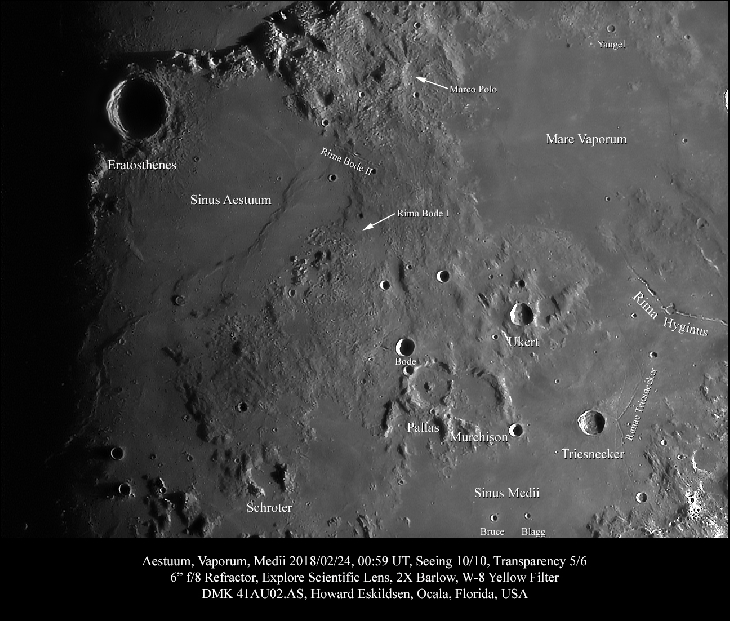
Aestuum Vaporum Region
The central part of the image shows rugged material ejected from Mare Imbrium, part of which lies just north of Eratosthenes in this image. The ejecta is embayed by basalt lava flows in Sinus Aestuum on the left and Mare Vaporum on the right, forming what resembles an isthmus of rubble in the upper central image. This ejected rubble fans out in the central image, where it encounters other lava flows including Sinus Medii, which is near the center of the Moon.
Pallas and Murchison show scars from the fluidized Imbrium ejecta and obviously predate the Imbrium basin. Since the lava flows have covered parts of the ejecta, they obviously came later. Signs of volcanic activity are also apparent by the collapse pits along Rima Hyginus, and one north of Rima Bode II (name from LAC-59). Faint Rima Bode I is barely visible as a pale outline that resembles a "thumbs up," with the thumb pointing to the upper left. I would not have noticed it had it not been listed on LAC-59.
Other signs of volcanic activity appear as pyroclastics; one north of Rima Hyginus, One in the region of Rima Bode I and II, and one north of Schroter. The pyroclastics are darker than their surroundings and are more easily seen with higher sun angles. Such areas have been suggested as targets for future Moon exploration due to high potential for scientific yield and as possible sources of hydrogen and oxygen. If such resources exist in quantities that can be recovered to make water and rocked fuel, it would have profound implications for space exploration and colonization.
Photographer's website:
No URL provided.
|
|
|