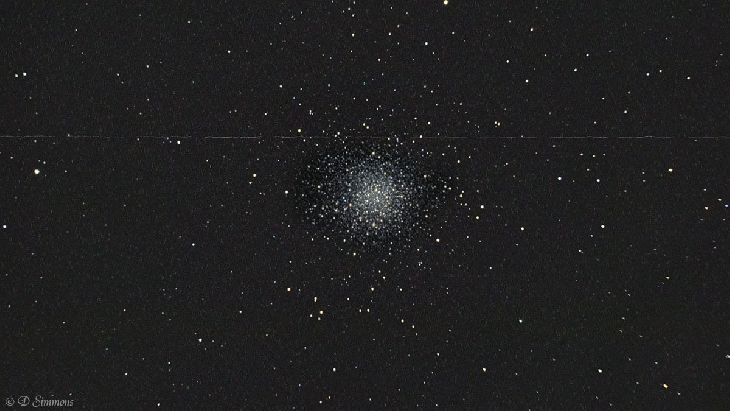
NEO 2010 WC9 passing Messier 10
Taken by Dennis Simmons on May 15, 2018 @
Brisbane, Qld
Click photo for larger image

| |
Camera Used: Canon Canon EOS 7D Mark II
Exposure Time: 60/1
Aperture: Unavailable
ISO: 1600
Date Taken: 2018:05:16 10:53:09
|
|
| More images
Details:
On the evening of 15th May 2018 (AEST) NEO 2010 WC9 glided past the magnificent Globular Cluster Messier 10 (M10) on its way to making its closest approach to our planet.
Estimates of the size of 2010 WC9 range from 197 to 427 feet (60-130 meters). The estimated close approach distance to our home planet is some 0.53 LD, which translates to approx. 126,400 miles (203,400 km).
I decided to use my Canon 7D Mk II to record this event as it has a larger sensor, and sensor real estate is crucial in locating and recording these fast moving objects.
After downloading the latest elements in The Sky X Pro, I slewed to the plotted position and began a series of test exposures, but NEO 2010 WC9 was nowhere to be seen. I checked my Latitude & Longitude values and the computer time, as these are crucial settings due to the significant effects of parallax for these close approaches.
Still, the recalcitrant NEO stubbornly refused to make an appearance so I quickly ran upstairs and checked the desktop PC and it agreed with the notebook located outdoors, at the telescope. So, I decided to keep recording and sure enough, 2010 WC9 entered from stage left (orientation of Canon 7D). I was thrilled to have picked it up, at mag 12.3 to 12.1 as the night progressed. It was some 5 minutes late…
Confident that I could now locate the NEO, I slewed the ‘scope to M10 and began the preparations to record the red dot as it approached the globular cluster. It took 11 frames at 60 secs exposure to traverse the field of view, with a 5 second pause between each frame to prevent camera shake caused by the shutter opening.
The “wobbly” appearance of the trail is as a result of periodic errors in the telescope mount’s gear train, as I was imaging at a relatively long focal length of 1932mm. This appearance is not caused by the asteroid tumbling!
Equipment details:
Tak Mewlon 210 F11.5
Tak x0.8 Reducer
Canon 7D Mk II DSLR
EFL 1932mm
Image details:
UT:
2018-05-15
13:42 – 13:54
Date: 15/05/2018 AEST
23:42 to 23:54 PM AEST
Magnitude: 12.16
RA Rate (arcsecs/sec): 0.153442
Dec Rate (arcsecs/sec): -2.725702
Constellation: Ophiuchus
The FOV of the original frames was approx. 40x27 arcmins, with an image scale of 0.44 arcsec/pixel
60 sec exposures
11 Frames
5 sec pause between frames.
Processing:
I opened the 11 Frames as Layers in Photoshop CC and performed an “Edit-Align Layers” function to align all the frames. I then set the “Blending Mode” to “Lighten” so the 11 dashes of WC9 magically appeared at the top frame in the Stack.
Back in the 1780’s, as he was compiling his famous Messier Catalogue, I wonder what Charles Messier would have thought about the capability of today’s amateur astronomical equipment and techniques? Over the course of his career, Messier discovered forty nebulae and 13 comets.
Cheers
Dennis
Photographer's website:
No URL provided.
|
|
|