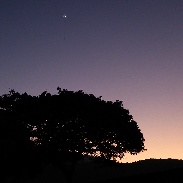
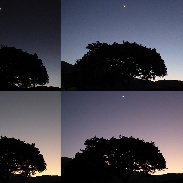
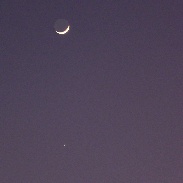
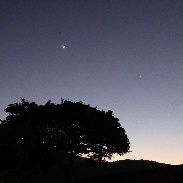
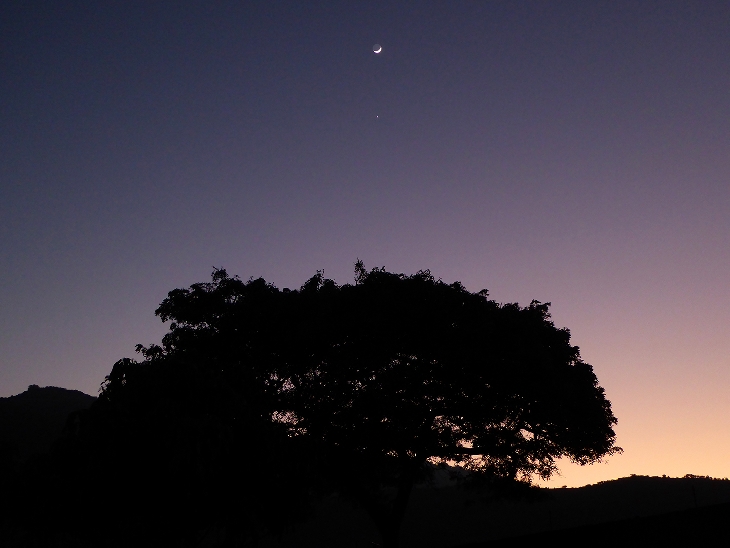
Waning Moon and Venus at Dawn
Taken by Peter Lowenstein on July 20, 2017 @ Mutare, Zimbabwe
Click photo for larger image
  Camera Used: Panasonic DMC-TZ60
Exposure Time: 10/150
Aperture: f/3.8
ISO: 400
Date Taken: 2017:07:20 12:46:01
 
More images
Details:
Early this morning (20 July) the Waning Moon and Venus shone brightly above a beautiful emerging sunrise twilight arch in the eastern sky over Cecil Kop Nature Reserve. The unusual lilac and magenta colors were similar to those produced by volcanic aerosols in the upper stratosphere following the eruptions of Calbuco Volcano in 2015. The red star Aldebaran (far right) and another small white one (above Venus) are also visible in the last photograph which was taken as dawn was breaking. The camera used was a Panasonic Lumix DMC-TZ60 in sunset scene mode.
Photographer's website:
No URL provided.
Comments
  You must be logged in to comment.  
The reddish star to the right of Venus, and a little lower than it, is actually Betelgeuse. Aldebaran is the star above the Moon, which is above Venus.
Posted by JoeStieber 2017-07-21 02:11:19
Thanks Joe, that makes the catch more interesting as Aldebaran does show any hint of orange color as might be expected.
Posted by PeterL 2017-07-21 05:50:20
Im familiar with the area around Venus and Aldebaran now. Ive been following their relative positions the past month, so I was able to identify them almost immediately in your fourth picture, even though theyre turned at an unfamiliar angle for my 40°N perspective (some of my recent pictures of them are here: http://sjastro.org/). Judging by the position of the moon relative to Venus and Aldebaran, I gather your pictures were taken around 6 am local time (UT+2?). I was taking pictures around 4 am EDT (UT-4), so I was probably seeing the arrangement about 4 hours after you, hence the moon would have moved a couple of degrees in that time with respect to the background sky (not taking into account any effects from parallax due to the much-different locations). As far as star color goes, that can be tricky with snapshots, especially if any color balance adjustments are made to improve the appearance of the sky. This was especially difficult on July 20 under height-of-the-summer conditions... hot, humid and hazy (which magnifies the effect of light pollution in my suburban Philadelphia, PA, location). In any case, Betelgeuse is redder than Aldebaran, so its color in the fourth pictures shouldnt be too great a surprise.
Posted by JoeStieber 2017-07-21 13:49:52
 
The Northern Lights: A Magic Experience
Aurora photo tours
Support SpaceWeather.com
Home | FAQ | Contact the Webmaster
©2019 Spaceweather.com. All rights reserved.